DeepCrawl (now Lumar) review: crawl speed, CI/CD SEO tests, AI visibility tracking, credit metering and what contracts really cost, checked October 2026.
Table of Contents
People still type "DeepCrawl" into search boxes four years after the name went away. On 29 September 2022 the company announced that "Deepcrawl is Now Lumar", and the product has kept moving since. It launched in 2010 as a cloud crawler you pointed at a site. Today it is a sales-led enterprise suite with four modules - Analyze, Monitor, Protect and Impact - plus reports on how a brand shows up in ChatGPT, Gemini, Perplexity, Google AI Overviews, Google AI Mode and Claude.
So the useful question is not whether DeepCrawl still crawls well. It does. The question is whether what it turned into is worth a contract you cannot price until a salesperson calls you back.
No hands-on test was run for this review. Lumar offers no self-serve signup and no advertised free trial, only "Get pricing" and "Book a demo" buttons (checked October 2026). Everything below comes from Lumar's own pages and help centre, plus two named third-party pricing sources.
Lumar says that in its own tests the crawler "has achieved crawl speeds up to 450 URLs / second (non-rendered) & 350 URLs / second (rendered)". Those are vendor figures, and no independent benchmark matches them. For JavaScript, the crawler "takes full advantage of Google's industry-leading rendering and parsing engine", which matters if your product pages assemble themselves in the browser.
The opposite setting exists too. Stealth mode "runs at 1 URL every 3 seconds, and the user-agent and IP address is randomized for each request". That gets past a firewall that blocks fast crawlers, and it is slow: 10,000 URLs take more than eight hours.
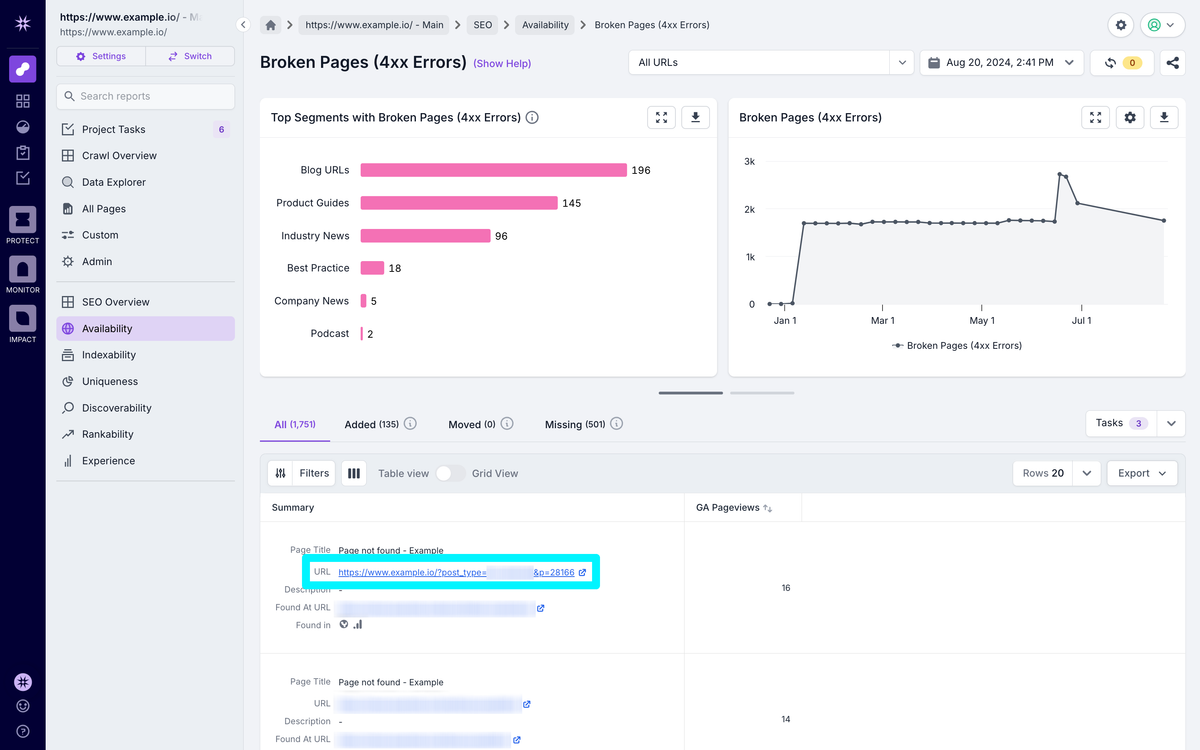
Analyze is where a crawl lands, with reports on GEO (AI search), technical SEO, site speed, web accessibility and custom analytics. Monitor and Impact sit on top of it, and the pricing page does not say which modules a contract includes by default.
The data around the crawl is usually what decides an enterprise purchase. Lumar pulls in Google Search Console, GA4 and GA360 with conversion data, Adobe Analytics, and log files from Logz.io and Splunk. It pushes out to BigQuery, Tableau, Apache Zeppelin, Jira Cloud and Looker Studio, where it has an official Google Partner connector. A GraphQL API is "available for all users" under a fair-usage policy.
This is the feature that justifies Lumar for teams that ship often. Protect, "formerly known as Deepcrawl Automation Hub", runs SEO checks inside your CI/CD pipeline. It has more than 160 tests and plugs into Jenkins, GitHub Actions, CircleCI, TeamCity, Bamboo, CodeShip, Concourse, BuildBot and Google Cloud Build. It treats results the way a test suite should: "A Fail will stop your build and a Warning will send a notification".
Each run is capped at 10,000 URLs, so Protect checks a sample of templates on staging, not the whole site. The catch is that a stray noindex tag on a template outside the sample still reaches production. How many test suites you get "will depend on your Lumar subscription", which is one more number that only appears in the proposal.
Most of what Lumar shipped in the last 14 months points the same way. Dedicated GEO Reporting arrived in August 2025, and its categories were restructured on 22 April 2026. AI Visibility Tracking runs a set of prompts across ChatGPT, Gemini, Perplexity, Google AI Overviews, Google AI Mode and Claude, and records where your brand appears. On 9 October 2026 Lumar added Share of Voice and split its single AI Visibility Score into a Presence Rate and a Quality Score. The Quality Score is "weighted 75% on mention quality and 25% on citation quality".
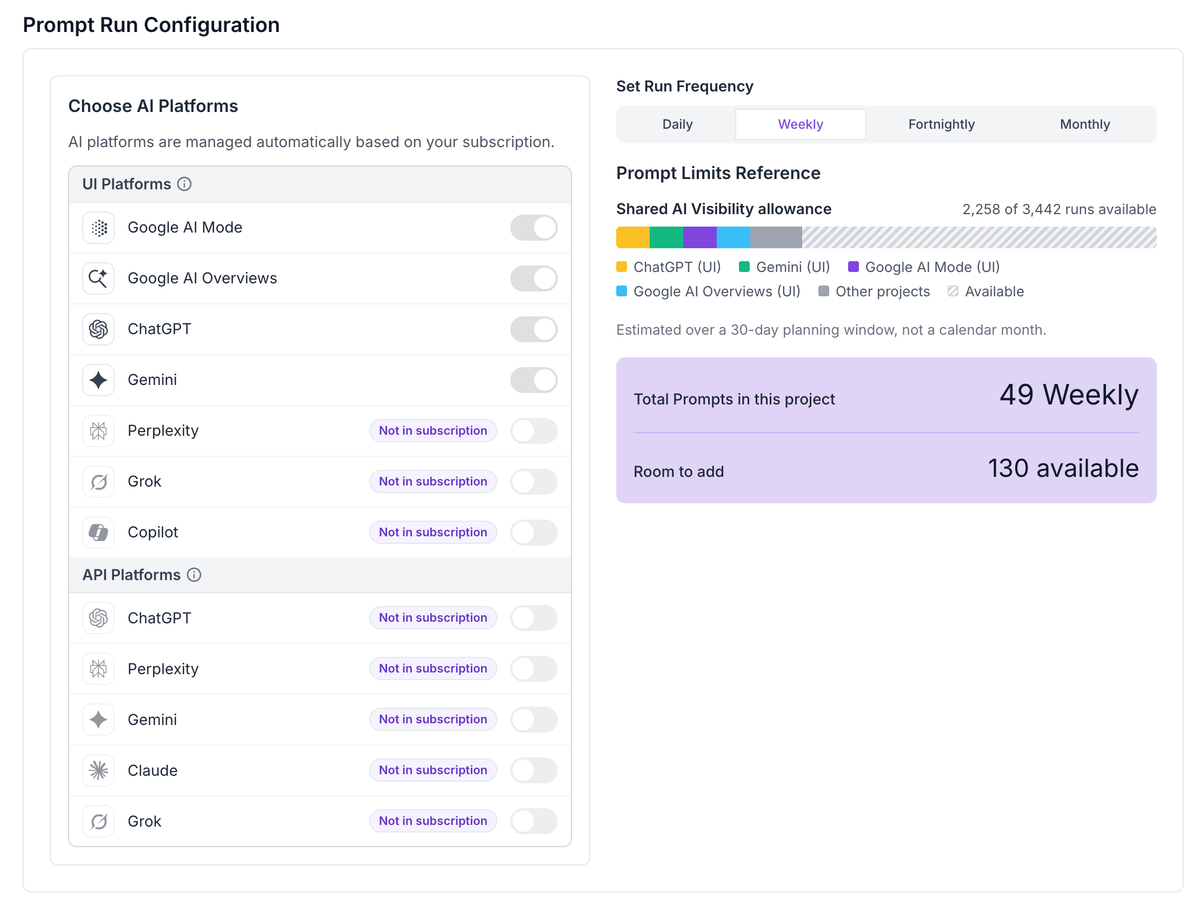
Two details from the release notes matter. First, prompts are limited per project, and the UI and API versions of each AI platform are "allowanced differently". Tracking ChatGPT as users see it and ChatGPT through its API therefore draw on the allowance in different ways. Second, coverage shifts: the September 2026 release lists Grok's UI as "temporarily unavailable". A Lumar MCP server, released in July 2026, also lets an AI assistant query your Lumar data directly.
Lumar's pricing page is a form. It promises "flexible pricing and packaging options" and lists no plan names, prices, seat counts or contract terms (page updated 5 March 2026, checked 13 October 2026). The FAQ explains the model: Lumar prices "based on your individual needs" and delivers "a tailored proposal". You can crawl any number of domains. What is metered is the number of active projects and "a set number of URLs that can be crawled in the billing period".
Two third-party sources fill the gap. Neither is official, and both were checked in October 2026.
| Source | Buyer or tier | Estimated cost per year |
|---|---|---|
| Vendr buyer guide | Company of about 200 employees | $14,500 - $28,800 |
| Vendr buyer guide | Company of about 1,000 employees | $26,200 - $51,900 |
| Vendr buyer guide | Over 1,000 employees | $42,500 - $93,400 |
| thestacc.com review | Mid-market, up to 500k URLs | $30,000 |
| thestacc.com review | Enterprise, up to 2M URLs | $60,000 |
| thestacc.com review | Large enterprise | $120,000+ |
Vendr also shows an "average contract value" of $58,175, but that figure comes from a single deal. Treat it as one data point. Vendr adds that longer commitments "can often result in significant price reductions". thestacc says contracts are annual only, and it lists the missing SMB tier and a steep learning curve as the main drawbacks. Either way, a team with less than about $15,000 a year to spend is not who Lumar is selling to.
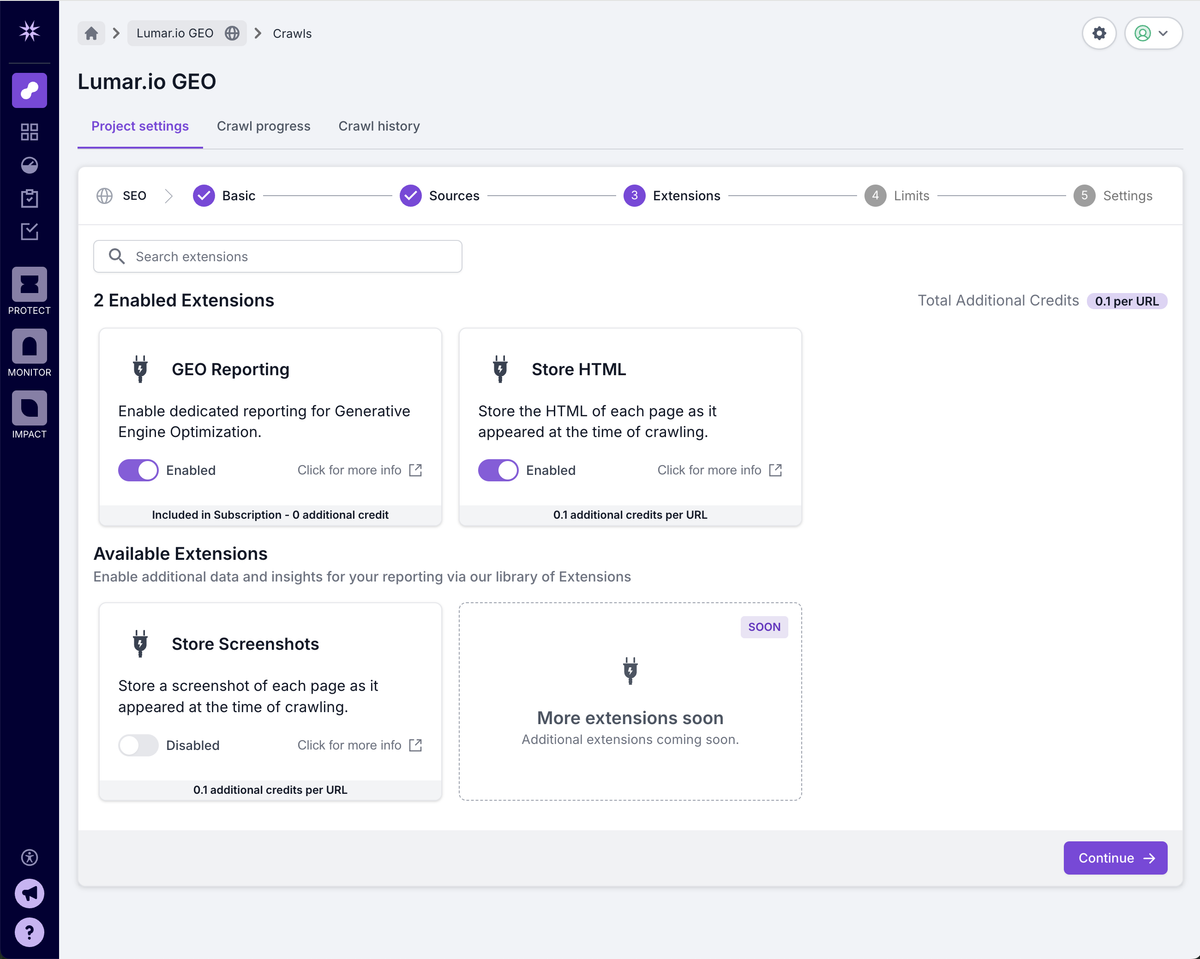
Then there are credits. Crawled URLs consume them, and extras raise the rate. Storing HTML and storing screenshots are Project Extensions at "0.1 additional credits per URL" each. Rendering with images costs "an additional 0.1 credits per rendered page". GEO Reporting is listed as "Reach out for pricing", and in Lumar's own screenshot it is included in that subscription at no extra credit, so it depends on the contract. Turn on the three paid extras for a 500,000-URL rendered crawl and they add 150,000 credits. If a plain URL costs one credit, that is 30% on top of the crawl before anyone opens a report.
Analytics come first. A Lumar project can take only one Google Analytics property, and GA4 data comes in over a 30-day window by default and 180 days at most. A brand spread across several GA properties therefore needs several projects, and every one of them counts against the active-project limit in your contract. Logs work the same way: manual uploads stop at 100MB, and Lumar cannot connect to Splunk Lite accounts.
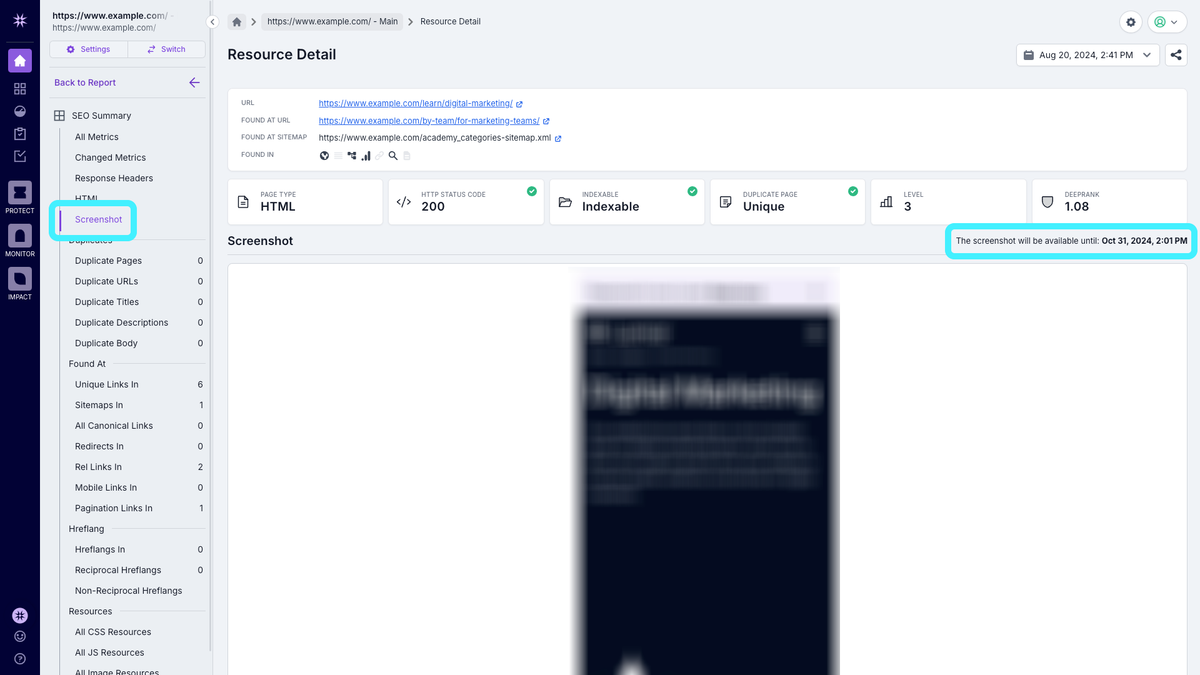
Storage is short. Stored HTML and screenshots from SEO crawls are kept for 90 days from the crawl, even though you paid extra credits to store them. If you need proof of what a page looked like before a migration six months ago, export it while you can. Segment data exports to CSV or to an XML sitemap.
Leaving takes a conversation, not a button. To cancel, Lumar tells customers to "get in touch with your Customer Success Manager". When the contract lapses, the account goes "dormant" instead of being wiped, and permanent deletion has to be requested specifically. Data sits on AWS, with crawl data on EC2 and reports and backups in S3. The FAQ names no region, which European legal teams will ask about. Lumar holds SOC 2 Type 2.
Skip Lumar if your site has fewer than a few hundred thousand URLs, nobody ships code to it every week, or there is no procurement budget. A desktop crawler such as Screaming Frog audits a small or mid-size site from a laptop for a fraction of a five-figure contract. For a cloud crawler without a sales cycle, Seobility is the low-cost crawl-first suite. OnCrawl is metered in tokens and built around log analysis.
At the enterprise end, Botify is the closest like-for-like rival, and it is also sold through a sales process. BrightEdge suits teams that care more about content and keyword reporting than about how deep the crawl goes.
Buy Lumar if you run a large or JavaScript-heavy site, your developers ship often enough for Protect to catch a bad release, and leadership wants AI-search visibility reported next to technical SEO. You are paying for crawling at enterprise scale, tests in the build pipeline and AI visibility reporting under one contract. The 160-test CI/CD gate is the part that is hardest to replace with something cheaper.
Do not buy it to find broken links on a 20,000-page site. Vendr's estimate starts at about $14,500 a year and there is no trial. Credits also make the real cost depend on how much you crawl and store. Get the proposal in writing with four numbers spelled out: the URL allowance, the active-project limit, the Protect test-suite count and the AI prompt limits. Those four decide whether DeepCrawl, under its new name, is good value or just an expensive crawler.
Visit the official website to see the latest plans, pricing, and special offers.
Get Started - Lumar (formerly DeepCrawl)* Affiliate link - we may earn a commission at no extra cost to you.