ZoomInfo Chorus Review: Call Recording That Now Comes With a ZoomInfo Contract
ZoomInfo Chorus review: call recording, AI summaries and coaching metrics, estimated pricing, contract terms, consent and AI-training gaps, and how it compares to Gong.
Expert Review

What Chorus is in late 2026
Chorus started as Chorus.ai, a 2015 startup founded by Roy Raanani, Micha Breakstone and Russell Levy that recorded sales calls and told managers what happened on them. ZoomInfo bought it in July 2021 for about $575 million in cash. Five years on, the product still records, transcribes and scores calls. What has changed is where it sits.
chorus.ai now redirects to a page on zoominfo.com. Chorus is not in ZoomInfo's top navigation - you find it under Solutions, then Engagement, listed as "Conversation intelligence". The headline products are Copilot, GTM Workspace, GTM Studio and an MCP server, and the company changed its stock ticker from ZI to GTM in May 2025 to match. On the pricing page, checked in November 2026, none of the six plans (ZoomInfo Professional, Copilot Advanced, Copilot Enterprise, Demand, ABM Lite, ABM Enterprise) lists Chorus as a feature. It gets a separate "Learn More" block underneath. There is no free trial, only a demo request form.
That matters more than any feature. Buying Chorus today means buying from ZoomInfo's sales team, on ZoomInfo's contract, usually next to whatever else they want to sell you. Even ZoomInfo's free self-serve entry point, GTM.ai with 1,000 data and 1,000 AI credits and no card, does not mention Chorus by name.
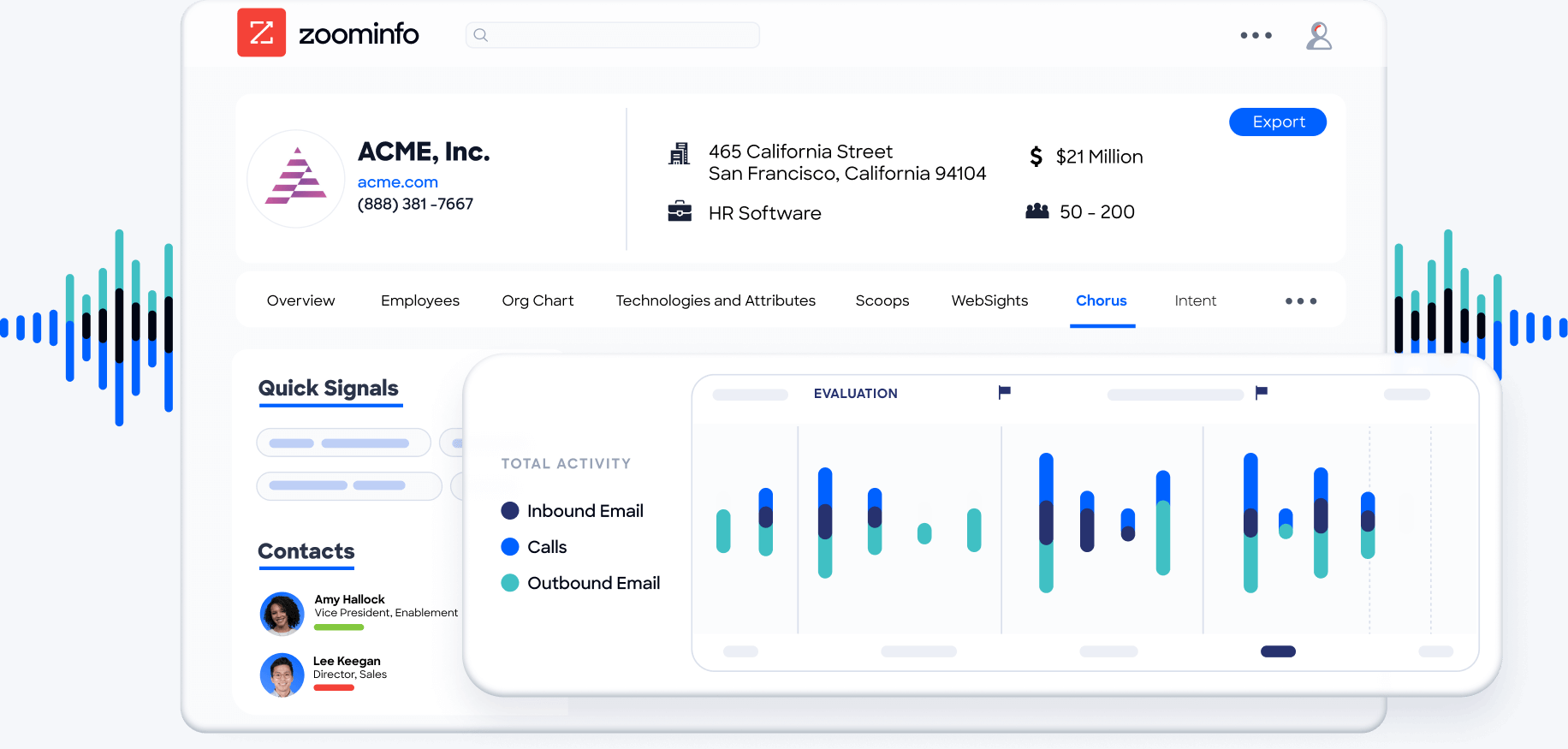
Recording, transcripts and coaching
The core loop has not moved. A bot joins the meeting - on Zoom it is plain to everyone, with a "Recording... on Zoom with Chorus" bar across the call - and the recording, transcript and AI summary arrive a few minutes after the call ends. ZoomInfo says the summaries pick out action items, and it claims "same room speaker separation" for several people sharing one microphone. A screenshot on its own product page claims transcripts are "18% more accurate than the nearest competitor". That is ZoomInfo's number. It does not name the competitor or the test.

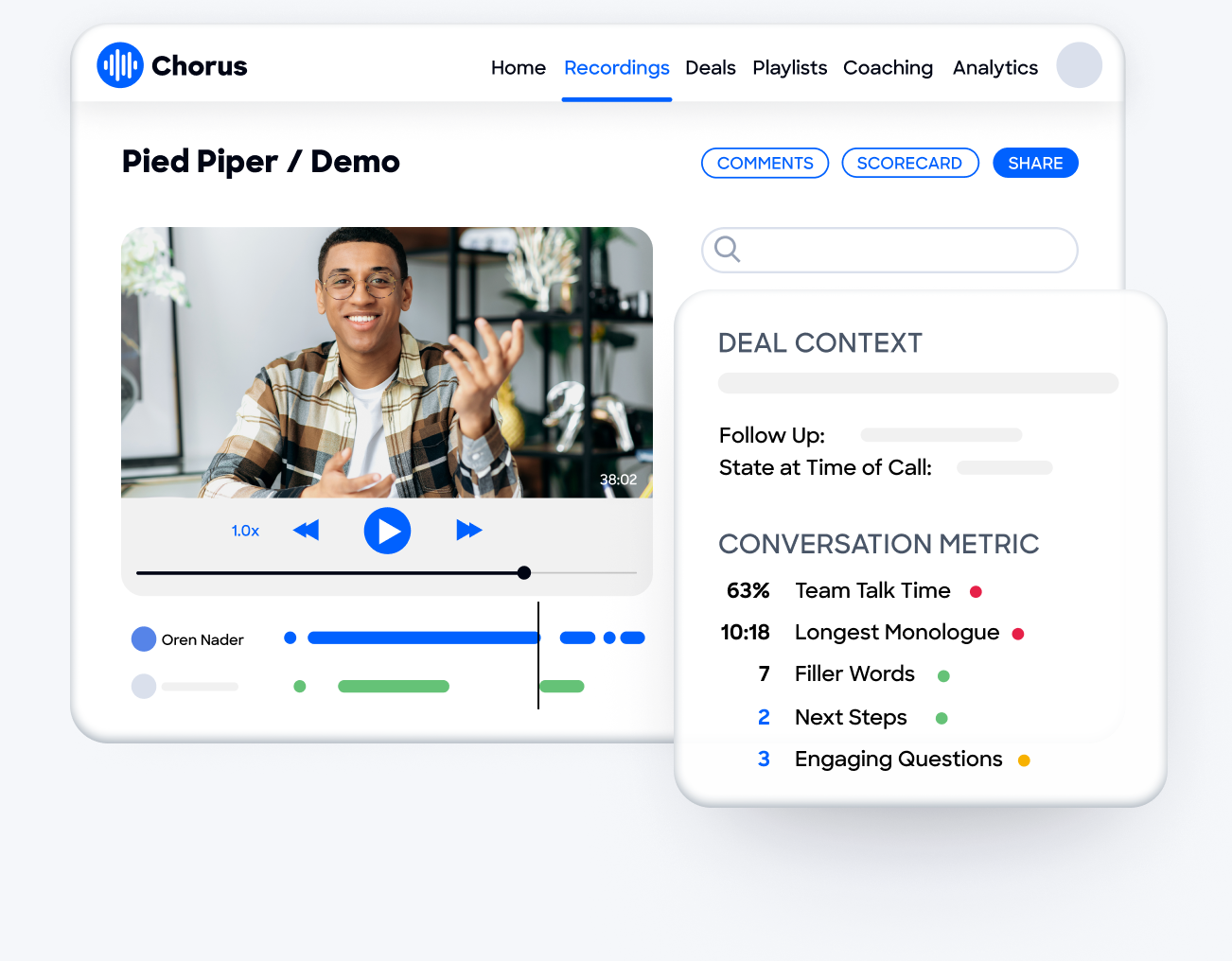
The call player shows the numbers managers coach from: team talk time (63% in ZoomInfo's example), longest monologue, filler words, next steps and engaging questions, with a Deal Context panel beside the video pulling in the opportunity. There are iOS and Android apps for listening between meetings.
Reviewers like the summaries most. On G2, where Chorus averages about 4.5 out of 5 from nearly 3,000 reviews, the praise is mostly about time saved writing notes after calls and how easy it is to set permissions team by team. The complaints repeat too: transcription that is "hit or miss, especially when there are multiple speakers or crosstalk", video that takes a while to process, the occasional call that never recorded, and search that cannot find a moment you know is there. Android users report the most app bugs.
Language is the other thing to test. TrustRadius and Capterra list English only, G2 lists eight more languages, and a TrustRadius reviewer said Spanish and French calls often were not detected. If a third of your calls are not in English, bring one to the demo.
Integrations are described only in general terms - video conferencing, sales engagement, CRMs. The old Chorus integrations page now points at ZoomInfo's marketplace with no readable list, so Zoom is the only connection the product page names outright. Ask about your own stack by name, Teams and your CRM first.
Pricing and the contract
ZoomInfo publishes no price for Chorus. Every number here is someone else's estimate.
The most specific comes from Convo, a competitor, whose Chorus pricing page (updated April 2026) puts it at about $8,000 a year for three seats, roughly $222 per seat per month, with extra seats around $1,200 a year and two-year terms typical. Treat that as an opening position rather than a quote - it is one rival describing another. CostBench reports that ZoomInfo often comes within about 10% of a competing Gong or Avoma quote, so getting one of those first is worth an afternoon.
The contract is where Chorus costs the most. ZoomInfo's public license terms (version of May 1, 2025) say: "The Agreement is not cancellable and shall remain in effect until it expires or is earlier terminated according to its terms." If ZoomInfo ends it over your breach, the fees for the rest of the term fall due at once. Renewal and notice periods live in the order form, which is not public. Users report a 60-day cancellation notice window, one reviewer said a cancellation sent 45 days ahead was refused, and a G2 discussion is titled "Sneaky auto-renewal clause in ZoomInfo contract". A shareholder lawsuit alleged "manipulative and coercive" auto-renewal practices - an allegation, not a finding. Put the notice deadline in a calendar the day you sign.
Call data, consent and AI training
Chorus records your customers, so the data questions are not optional. ZoomInfo answers fewer of them than Gong does.
Consent is yours to handle. The Conversational Intelligence Service Addendum makes the customer "solely responsible for making any required notices ... and for obtaining any required consents". We found no published Chorus consent workflow; Gong documents its recording-consent settings in its help center. In two-party-consent states and most of Europe, your legal team writes the notice.
Training is unanswered. The privacy policy (updated October 2025) says ZoomInfo "may reproduce, analyze, summarize, and disclose" Chorus recordings with customers, and may use usage data to "test, develop, improve, and enhance" its services, derivative works included. It does not say whether call recordings train AI models, either way. The sub-processor list (updated July 17, 2026) names Anthropic, OpenAI, Google and Groq for generative AI across ZoomInfo as a whole, without saying which product uses which. If that matters to you, get a no-training clause into the order form.
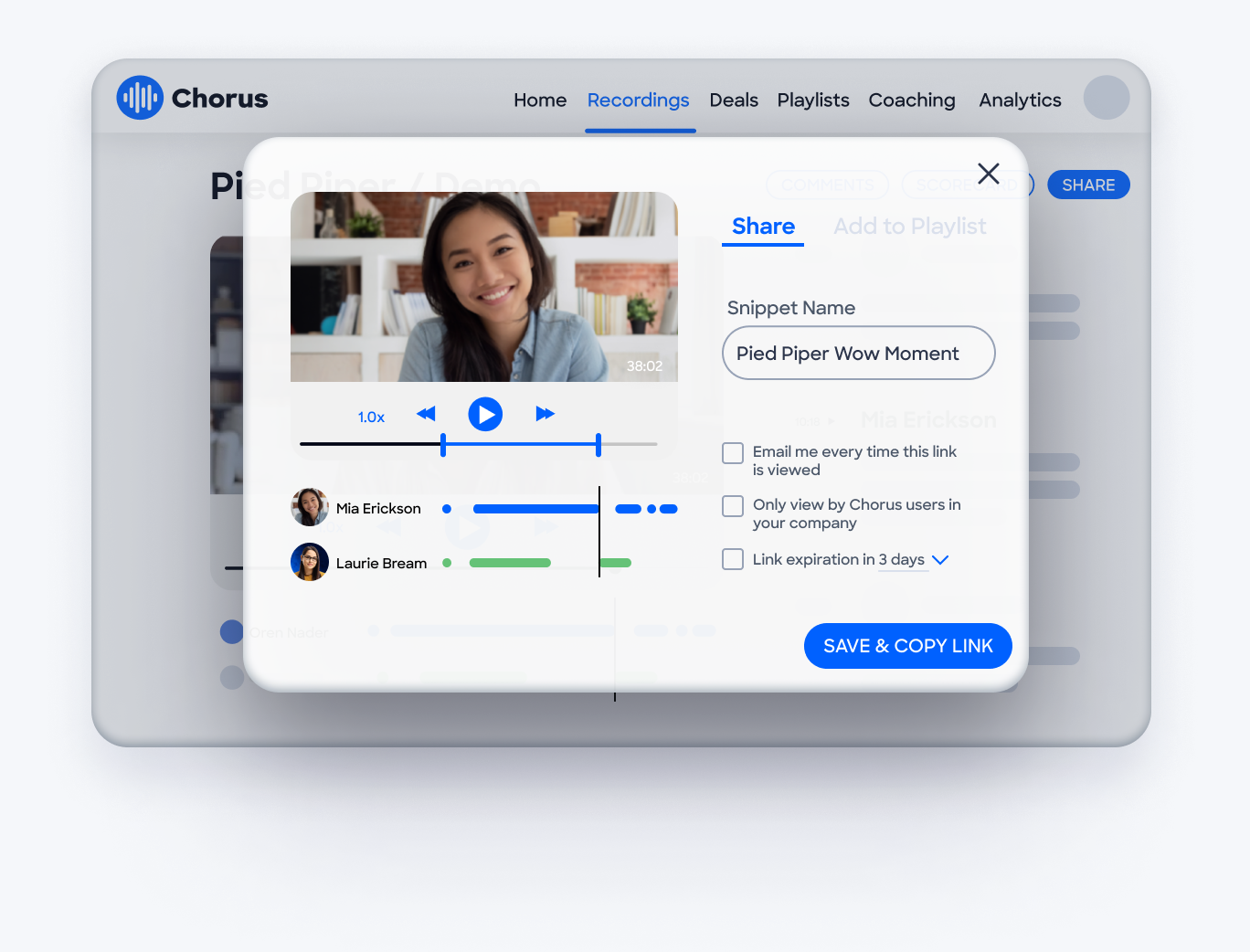
Shared clips are the one place with visible controls: a snippet link can expire and email you when someone opens it. Retention has no published default. The license terms say uploaded data is destroyed when the agreement ends, so export the calls you want to keep before the last day, not after. On security, ZoomInfo holds ISO 27001, 27701, 27017 and ISO/IEC 42001 certifications and a SOC 2 Type II report, encrypts data at rest with AES-256, and hosts on AWS and Google in the US. No EU region is stated for Chorus.
Chorus vs Gong and lighter tools
Gong is the comparison every buyer makes, and the site has a full Gong review. Both record, transcribe and score calls, and both are quote-only on annual or multi-year terms. The difference is what you are buying into. Gong is a standalone revenue platform with its own forecasting and engagement tools, and it publishes its consent and admin settings. Chorus is the conversation layer of a data company, and its best argument is that a rep's call sits next to ZoomInfo's contact and company data for the same account.
Teams already on Outreach or Salesloft should check what their engagement platform records first. Paying a second vendor for the same job is hard to defend. And for three to ten reps who mostly want call notes and summaries, a meeting note-taker on a monthly plan covers it for a small fraction of an estimated $8,000-a-year, two-year commitment, and lets you leave when it stops earning its keep.
Verdict
Buy Chorus if you already pay ZoomInfo for data, your renewal is coming up, and you want call recordings and coaching on the same contract and the same account pages. In that position the bundle is the point, and you have leverage: ask for Chorus as its own line item, a one-year term and a written no-training clause.
Skip it if conversation intelligence is all you need. You would be signing a non-cancellable ZoomInfo contract for a product ZoomInfo no longer puts in its menu or its price list. Gong is the better standalone buy for a large sales team; a lighter note-taker is the better buy for a small one. Whichever way you go, run a multi-speaker call and a non-English call through the demo before signing, because that is where Chorus reviewers say it slips.
Ready to try Chorus?
Visit the official website to see the latest plans, pricing, and special offers.
Get Started - Chorus* Affiliate link - we may earn a commission at no extra cost to you.