Outreach Review: Seats Plus AI Credits, and No Price on the Page
Outreach review: four quote-only Amplify tiers with pooled AI credits, a $45,600 median contract, one-way HubSpot sync and templates you cannot export.
Expert Review

Outreach now sells agents, not seats
Type outreach.io into a browser and you land on outreach.ai. The redirect is permanent, and the page behind it opens with "Stop buying software. Start hiring AI agents." Odd, for a name that became shorthand for email sequencing, but accurate.
The Seattle company, founded in 2014 and run since September 2024 by CEO Abhijit Mitra, has spent two years rebuilding itself around agents. Deal Agent and Research Agent went generally available in August 2025. The Spring 2026 release on 27 April added Omni, a chat agent that answers questions and takes actions across the platform, and Agent Studio, a visual builder for custom agents. In October 2026 Gartner named Outreach a Leader in its Magic Quadrant for Revenue Action Orchestration for the second year running. The old Engage, Call, Meet, Deal and Forecast packages are gone. What you buy now is one of four Amplify tiers, each carrying a pool of AI credits.
The sequencer is still there, and still good. What changed is how you pay for it.
Pricing: four tiers and not one number
The pricing page, checked on 14 November 2026, lists Amplify Essentials, Core, Plus and Pro, and every one of them says "Request pricing". The only commercial terms in writing are "Per user pricing. No platform fees. Support included." Seats are licensed per user; the AI is metered on top.
| Tier | AI credits | API calls | What it adds |
|---|---|---|---|
| Essentials | 10,000 | not listed | Conversation intelligence, Outreach Voice dialer, Omni, Research, Deal and Meeting Prep agents |
| Core | 25,000 | 250,000 | Sequences and multichannel engagement, Revenue and Personalization agents - but no Deal Agent |
| Plus | 50,000 | 500,000 | Everything in Essentials and Core |
| Pro | 100,000 | 1,000,000 | Forecast projection, scenario planner, territory management, multi-currency |
Read that table twice. Essentials, the entry tier, has no sequences at all - it is a call recorder with a dialer. Core has sequences but drops Deal Agent. A team that wants to prospect and inspect deals in one product is a Plus customer, which may be why Outreach labels Plus "Most Popular!".
Since the vendor will not print a price, the best evidence is what buyers paid. Vendr's data from 922 purchases, updated February 2026, puts the median at $45,600 a year, with a range of $8,700 to $215,398. An older AWS Marketplace offer for 50 seats under the retired "Orchestrate" name is $108,000 for 12 months, roughly $180 per seat per month, and its terms say all fees are non-cancellable and non-refundable. Comparison sites quote $100, $130 and $160 per user per month for Core, Plus and Pro, plus a $5,000 to $25,000 onboarding fee. Those come from competitor-affiliated blogs: expectations, not budgets.
Connectors, data sharing, extra instances and listener licences are add-ons, and dialer usage comes on top.
AI credits: one pool, no per-user brakes
Each tier's credit allowance belongs to the org instance, not to people. The help centre says credits are spent through "discrete actions" with "a predictable credit cost", yet no public page lists what a research run or a drafted email actually costs, and nothing prices the extra credit packs you can buy "at any time".
The detail that matters most sits in a support article: "There is currently no way to set per-user AI credit limits." A single rep who schedules a nightly Research Agent run across a few thousand accounts draws from the same pool as everyone else. Admins find out through email alerts at 50%, 80%, 100% and 102% of usage. The last one is the overage notice.
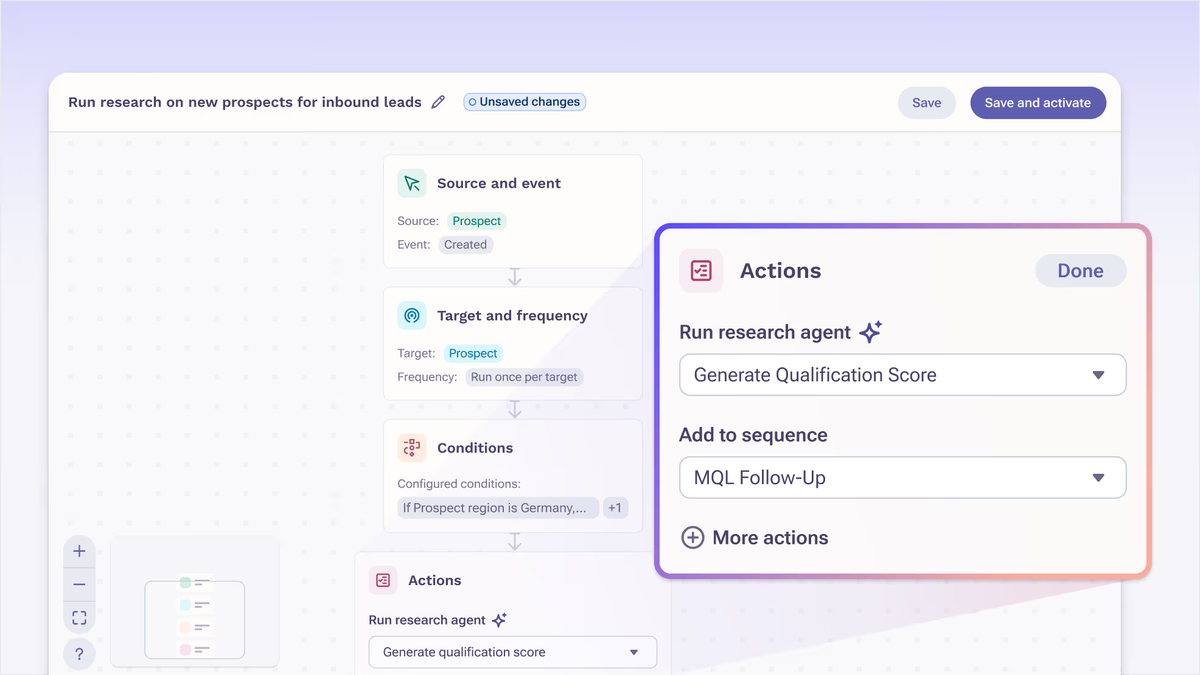
In September 2026 Outreach reported 12x growth in AI credit consumption and 480% year-on-year growth in AI revenue. Those are the vendor's own figures, presented as a success. Read from the buyer's side, they say customers are spending allowances fast enough to buy more. Before signing, get the credit cost of each agent action in writing, and the price of a top-up pack. One small relief in the November 2026 release: MCP connectors are flagged as not using Amplify credits.
What the agents actually do
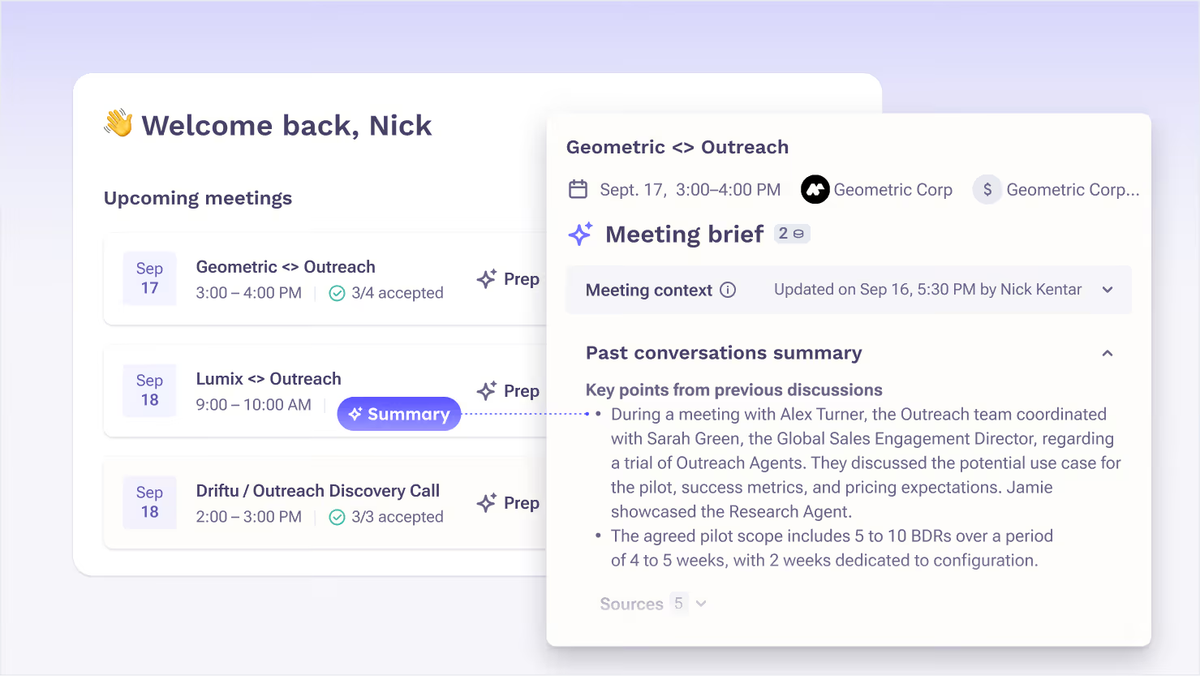
Strip the branding and the agents fall into three groups. Research Agent and Revenue Agent find and profile accounts, mixing Outreach's own engagement and call data with third-party public data. Personalization Agent turns that research into email, call and LinkedIn drafts for a rep to approve. Deal Agent and Meeting Prep Agent work the pipeline: the first proposes changes to opportunity fields and, since the Spring release, sends them to Slack for approval; the second writes a brief before each meeting. Omni sits over all of it as a chat box.
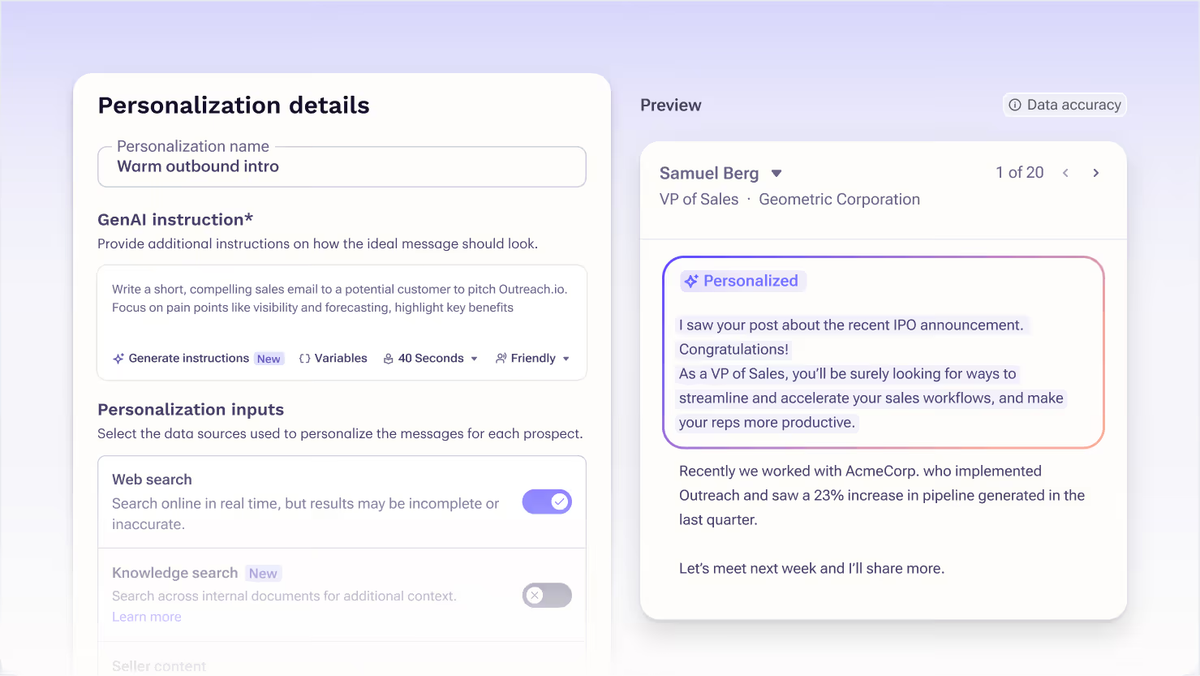
The agents are strongest where they read data Outreach already holds. Kaia, its meeting recorder, has been transcribing calls for years, and a research brief that knows what the prospect said on last month's call beats one assembled from LinkedIn. The weak spot is how much is still arriving. Reply Agent, which answers objections in email replies, was marked "Coming soon" on the agents page in November 2026, and the Spring announcement gave no general-availability date for its features.
Since June 2026 an MCP server and a ChatGPT app take the agents outside the Outreach tab, and since 15 September they can be bought through Salesforce AgentExchange.
Limits the sales deck skips
Outreach does not send email itself. Every message goes out through your own Google or Microsoft mailbox, each user gets two mailboxes unless the contract says otherwise, and there is a hard ceiling of 5,000 emails per week per mailbox across the web app, Chrome extension and Outlook add-in. For a ten-rep team that is 100,000 sends a week at most. Plenty for account-based selling. Tight for anyone treating Outreach as a bulk cold-email engine, which is the job Instantly is built for.
The dialer bills voice minutes and phone numbers on top of the seat price. Calls round up to the next minute and bridged calls count double, so a 61-second bridged call is billed as four minutes. No per-minute rate is published.
Kaia has catches of its own. It needs a Google, Outlook, Exchange or Office 365 calendar, and on Zoom the person who added Kaia has to stay in the meeting for the whole call.
Salesforce yes, HubSpot barely, Dynamics on-prem no
Outreach claims over 90 integrations, but the CRM is the one that decides the purchase. Salesforce is home ground, with two sync options: the Classic plugin and an Enhanced CRM Sync that was still in beta when we checked in November 2026. Even there, Capterra reviewers keep reporting that it "doesn't always sync well to Salesforce", and that setup needs someone from RevOps.
HubSpot is a different story. The help centre says the two "only support syncing emails from Outreach to HubSpot", records cannot be synced on demand, and the integration is maintained by HubSpot's engineers, so sync tickets go to HubSpot rather than Outreach. Microsoft Dynamics works only as cloud-hosted Dynamics 365 Sales; on-premise installs are not supported.
Signing, renewing and leaving
There is no free trial and no self-serve plan; every button leads to a sales call. Contracts renew automatically for 12 months at a time, and stopping that takes written notice at least 30 days before the term ends. Outreach can change the fee with 60 days' notice before a renewal, so a price rise can land just before your own window closes. Set a reminder 90 days ahead of the end date on the day you sign.
Leaving costs more than a notice letter. Prospects, accounts, opportunities, calls, tasks, sequence states, users and emails export to CSV, but "Templates and Snippets cannot be exported", so years of tuned copy have to be moved by hand. Call recordings are hosted by Twilio, and once the contract ends you lose the Outreach interface you would fetch them through; Outreach itself recommends downloading them first. The terms only promise to "try" to help you retrieve data after termination, with no number of days attached.
Support targets look fine on paper: first response within one hour for a P1 on Standard, 30 minutes on Premier, 15 minutes on Elite. The same page adds that these "are not Service Level Agreements" and carry no financial penalty when missed.
Verdict
For a large Salesforce shop, Outreach is still one of two serious sales engagement choices, and its agents have a real edge where they can draw on years of recorded calls. Buy it if you run 20 or more sellers on Salesforce, have a RevOps person to own the setup, and want sequences, call recording, deal inspection and forecasting on one contract. Budget for Plus rather than Core, and negotiate the credit costs before the seat price.
Skip it if you are a team of five, if you live in HubSpot, or if you want to pay monthly by card. Salesloft is the like-for-like rival and, since merging with Clari, has forecasting built in - our Salesloft review covers what that merger changed. Smaller teams get self-serve multichannel sequences from Reply.io or Lemlist without a sales call, and Close gives an SMB team a CRM with the dialer built in. On HubSpot, read our HubSpot review before accepting a one-way sync.
Ready to try Outreach?
Visit the official website to see the latest plans, pricing, and special offers.
Get Started - Outreach* Affiliate link - we may earn a commission at no extra cost to you.