Close CRM Review: Built-In Calling, the Chloe AI Agent and Three Separate Bills
Close CRM review: plans from $9 to $149 per user, Twilio-rate calling, the Chloe AI voice agent and its credits, the Growth-only power dialer and the refund fine print.
Expert Review

Three bills, not one
Most CRM pricing pages sell you a seat. Close sells you a seat, then meters two more things behind it. Its own help centre puts it plainly: "Close has three separate billing areas: your CRM plan, telephony usage (calls, SMS, and phone numbers), and AI credits. These are billed and invoiced separately."
That structure decides whether Close is cheap or expensive for you. A team that mostly emails pays the seat price and little else. A team that dials all day pays Twilio-based minutes on top. A team that hands calls to Chloe, the AI sales agent Close made generally available on June 9, 2026, pays minutes and credits, and Close does not publish how many credits a minute of Chloe costs.
Close, a Y Combinator company founded in 2013, says it is bootstrapped and profitable with more than 11,500 business customers. It was built for one job: getting a small sales team on the phone with as many leads as possible, with every call, email and text logged on the lead automatically.
Pricing and what each plan blocks
All figures are per user per month, checked on close.com/pricing in November 2026.
| Plan | Monthly billing | Annual billing | What it adds |
|---|---|---|---|
| Solo | $19 | $9 | 1 user, 10,000 leads, calling, SMS and email. No workflows |
| Essentials | $49 | $35 | Unlimited leads, team inbox and task list. Still no workflows, no power dialer, no bulk email |
| Growth | $109 | $99 | Workflows, power dialer, bulk email, voicemail drop, Chloe in workflows |
| Scale | $149 | $139 | Predictive dialer, live call coaching, custom roles, lead visibility rules, custom objects |
The toggle says "save up to 50%". That is true for Solo, where annual billing cuts the price by about 53%. On Growth the saving is 9% and on Scale under 7%, so the annual commitment buys very little on the plans most teams actually need. Close's help centre adds that it discounts for teams with 10 or more seats signing for 12 months or longer, which is the real negotiation lever.
The line that matters is between Essentials and Growth. Essentials looks like the small-team plan, but without workflows or a power dialer it is a shared inbox with a phone attached. Every sequence, every automated follow-up and every "dial the next 200 leads" session starts at Growth. For a five-rep team that is $495 a month on annual billing before a single minute of calling.
Some limits only show up in the feature grid. Call recordings are kept 30 days on Solo and Essentials, 90 days on Growth and indefinitely only on Scale. Solo and Essentials connect 3 email accounts, Growth and Scale 10. Support on every plan is email plus a knowledge base; the grid lists no phone support tier.
The trial runs 14 days with no card and a small starter allowance (the pricing page says $5 of calling and enrichment credits, the help centre 1,000 AI credits). Afterwards the account pauses and data is kept "for a limited period before deletion".
Calling: the reason to pick Close
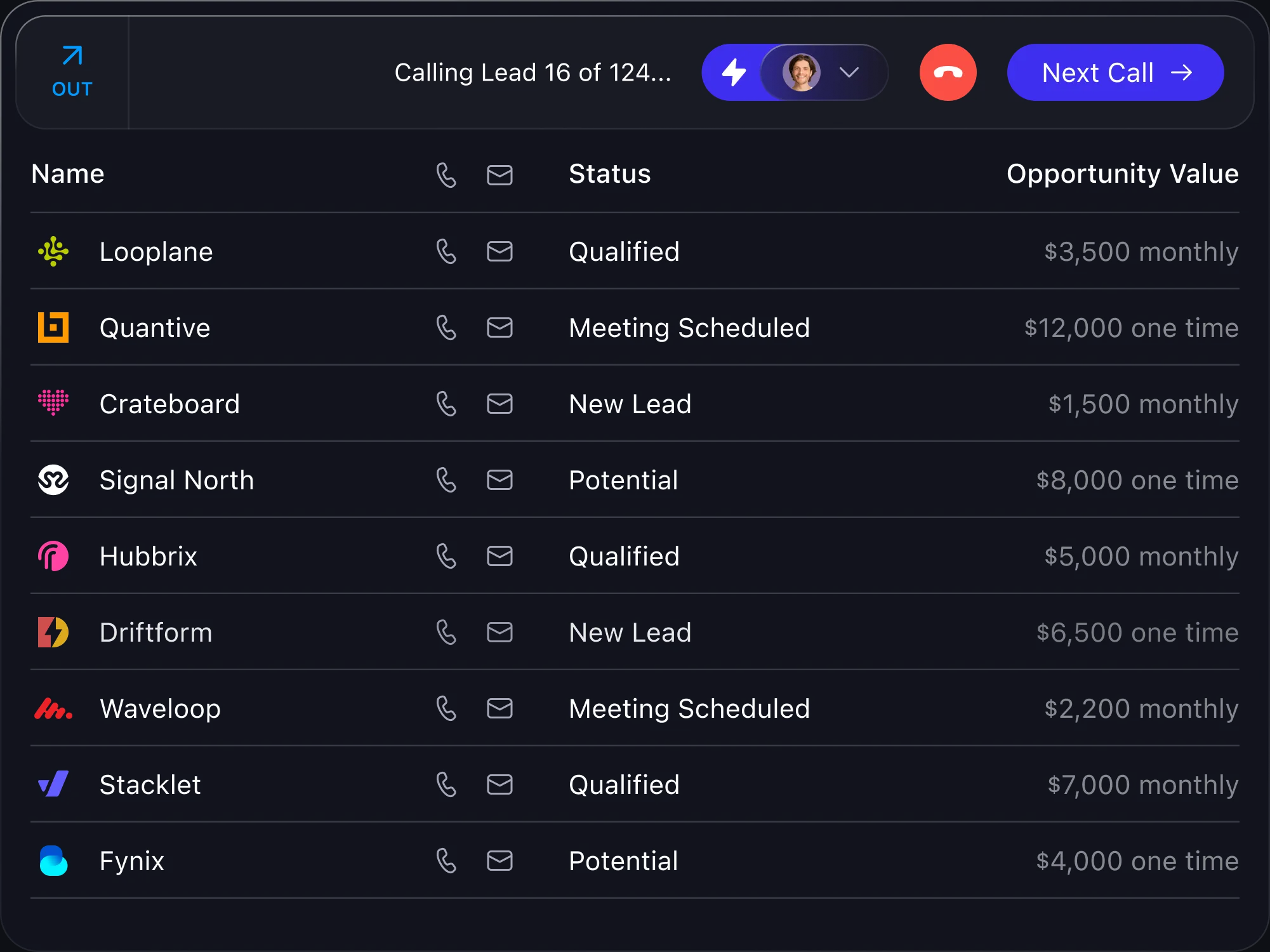
Calling and SMS work worldwide on every plan, from inside the lead record, with no separate phone system. Close passes usage through "at cost": most outbound calls run about $0.02 a minute and numbers start at roughly $1 a month. Rates follow Twilio's, and the detail that matters is rounding. Every call is rounded up to the next minute and cent, so a 70-second call bills as two minutes and a 15-second voicemail bills as one. A forwarded call is charged as two calls and a transferred call as "at least three".
A card has to stay on file for usage, and the default monthly spending limit is $100. Five reps each billing 1,200 minutes a month at $0.02 is $120, past that default in month one; raise it before a big calling day, not during one.
The power dialer (Growth) works through a list one lead at a time and drops recorded voicemails. The predictive dialer (Scale only) dials several numbers per rep and connects whoever answers, which is where the $40 jump from Growth to Scale pays for itself on high-volume outbound. Scale also adds listen, whisper and barge coaching on live calls.
Do not confuse the two transcription tools. Notetaker, for Zoom, Teams and Meet calls, is free on all plans. Call Assistant, which transcribes Close's own phone calls, is an add-on at $50 a month per organization plus $0.02 a minute, and only transcribes calls over 30 seconds.
SMS works in ten countries. US texting needs A2P 10DLC registration: a $4 or $44 brand fee, $15 campaign verification, then from $1.50 a month.
Chloe, the AI sales agent
Chloe left beta on June 9, 2026. Close says 306 businesses made more than 818,000 calls with it during the beta. As a voice agent it calls leads, qualifies them, answers questions from the knowledge sources you give it, books meetings, and writes the outcome, summary and transcript back to the lead record. Setup is a 3 to 5 minute call with Chloe herself, an automatic test call, then toggles for the skills it may use: transfer to a human, alerts, scheduling, booking and task creation.
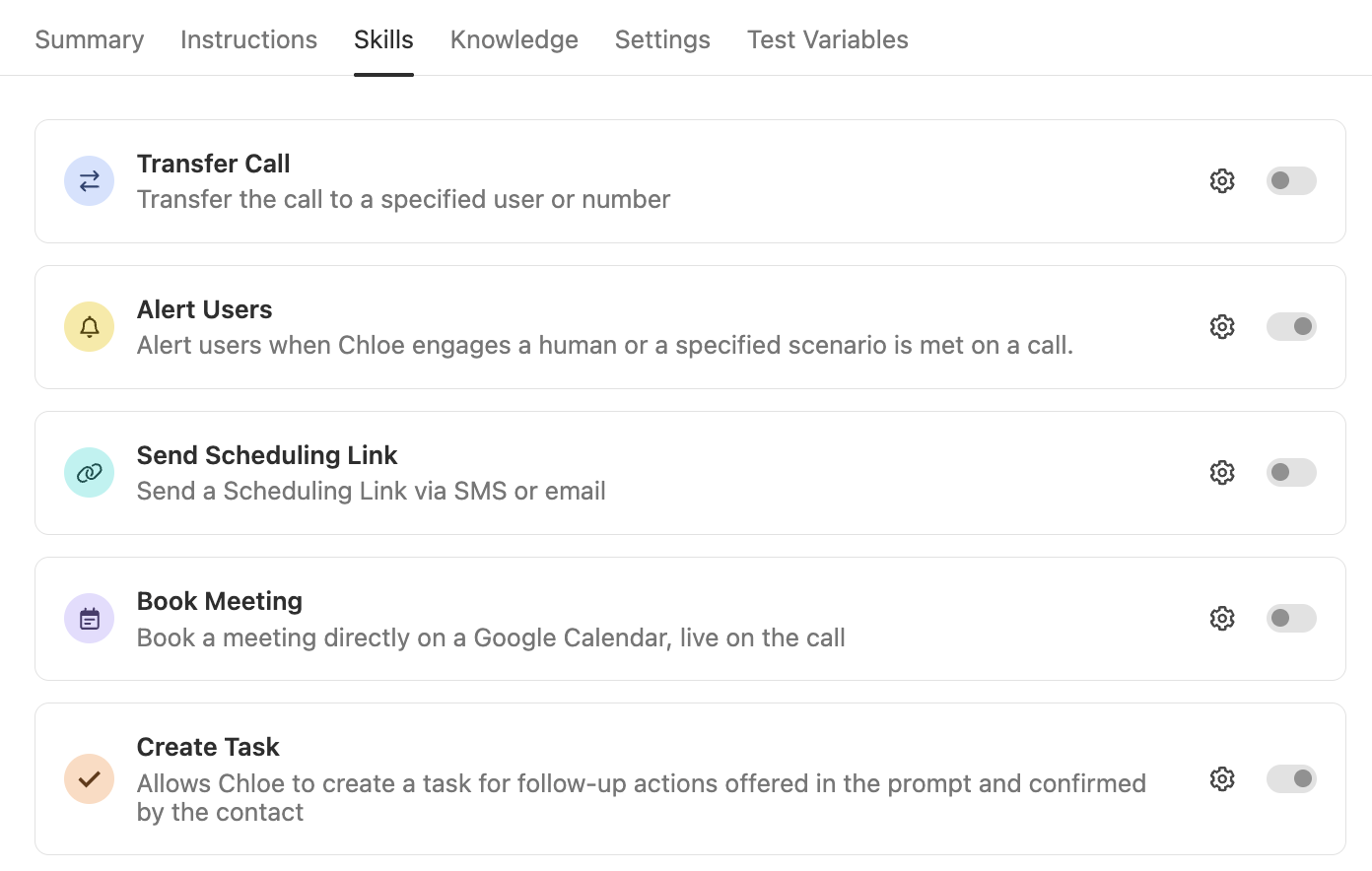
The limits are firm. Chloe only calls contacts in the US and Canada, only in English for now (multilingual support is listed as coming), and must announce at the start of every call that it is an AI assistant and that the call is recorded. That disclosure cannot be turned off. Email and SMS are "coming later", so today Chloe is a phone agent only.
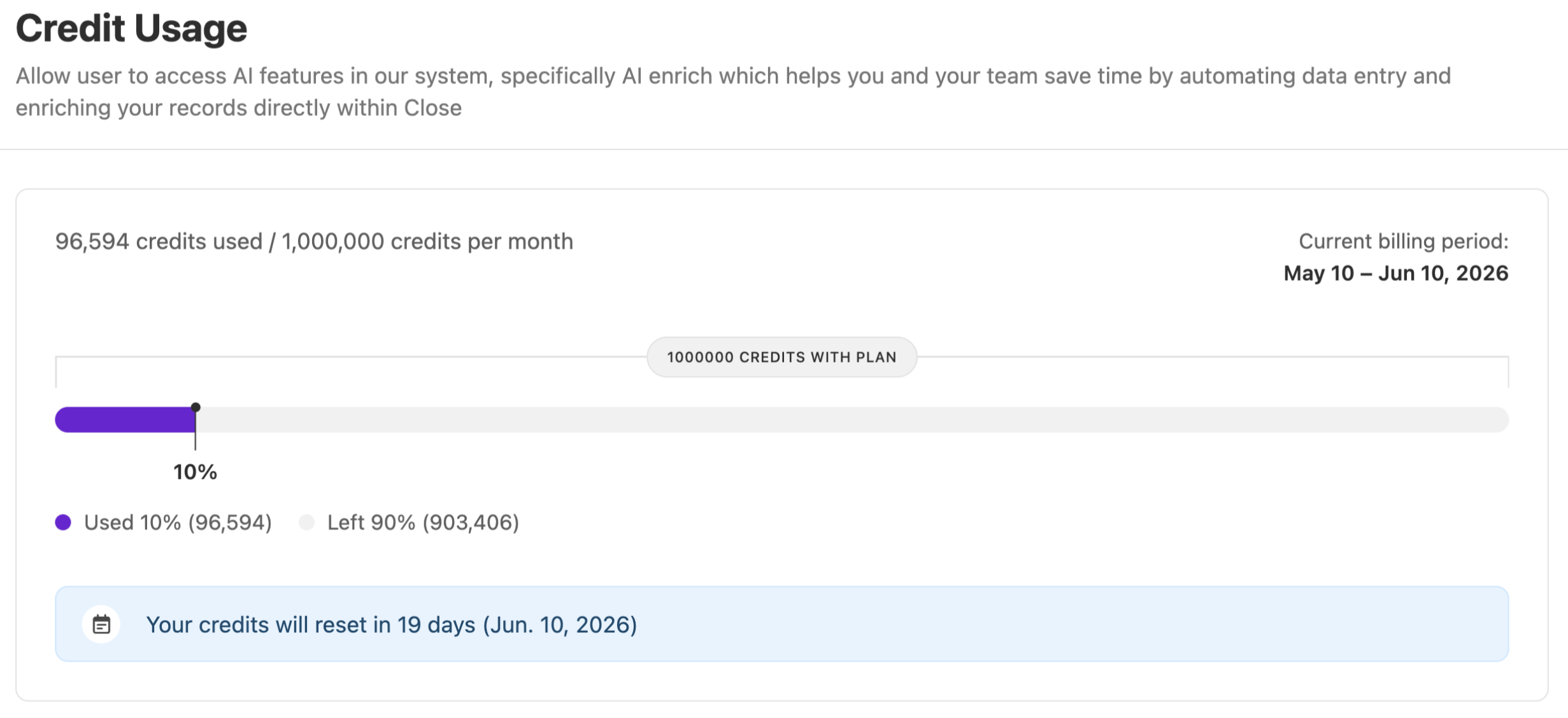
"Chloe access is free on all Close plans. You only pay for the work Chloe does." In practice that means each Chloe call is billed twice: telephony minutes like any other call, plus AI credits. Every plan includes a monthly credit pool: 500 on Solo, 1,000 per user on Essentials, 1,500 on Growth and 2,000 on Scale. The pools stop growing at 10 users (10,000, 15,000 and 20,000 credits), unused credits do not roll over, and the help centre says there is "no global credit cap or per-Voice Agent credit limit". When credits run out, Chloe and other credit features pause.
What is missing is the exchange rate. Close publishes that one enrichment action (one field filled on one record) costs 6 credits, and that top-ups run from $20 for 1,200 credits to $1,000 for 100,000. That puts an enriched field at 6 to 10 cents. It does not publish credits per minute of a Chloe call anywhere we could find, so the only way to budget a Chloe campaign is a small test batch and the usage dashboard. Simulated calls are free.
Not all AI burns credits. Notetaker, Chloe Chat (beta) and AI search are free on every plan; lead summaries and AI rewrite are free from Growth, which is also where Chloe joins workflows.
The fine print worth reading
The refund promise contradicts the contract. The pricing page offers a "30-day money-back guarantee. Get a full refund, no questions asked", while section 4B of the Terms of Service (updated October 31, 2025) says "All fees are non-refundable." If the guarantee matters to you, get it confirmed in writing before you pay for an annual plan.
Leaving costs you your numbers. The terms say that on downgrade or termination "you will forfeit any phone numbers associated with your account". If customers know your reps by their direct lines, port the numbers out before you cancel, not after.
Email is built for one-to-one selling, not campaigns. A regular connected mailbox is limited to 200 emails a day and 20 an hour, with at least 60 seconds between sends. A dedicated mass-email account (Mailgun or SendGrid) raises that to 2,500 a day. Third-party reviews say the same: strong on calling, thin on marketing, and no free plan.
Who should skip it
Teams that sell mostly by email and content should look at HubSpot, which has a free CRM and real marketing tools that Close does not try to match. Teams that want a visual pipeline and a cheaper entry to automation should compare Pipedrive, where workflow automation does not require a $99-plus seat. Companies with complex permissions and dozens of objects outgrow Close's Scale plan quickly and belong on Salesforce or Zoho CRM. And anyone outside North America buying Close for Chloe should wait: it cannot call your leads yet. Our CRM roundup compares the field side by side.
Verdict
Close is the strongest CRM we have reviewed for a small team whose day is spent on the phone. Calling, texting, recording and logging are built in rather than bolted on, minutes are close to Twilio cost, and Scale puts a predictive dialer within reach at $139 a seat.
Buy Growth, not Essentials: workflows and the power dialer are the product, and Essentials lacks both. Treat Chloe as a promising after-hours and re-engagement caller for US and Canadian leads, and budget for it by testing, since Close will not tell you what a minute costs in credits. Skip Close if your sales motion is email-led or international, because you would pay for a phone stack you do not use.
Ready to try Close?
Visit the official website to see the latest plans, pricing, and special offers.
Get Started - Close* Affiliate link - we may earn a commission at no extra cost to you.