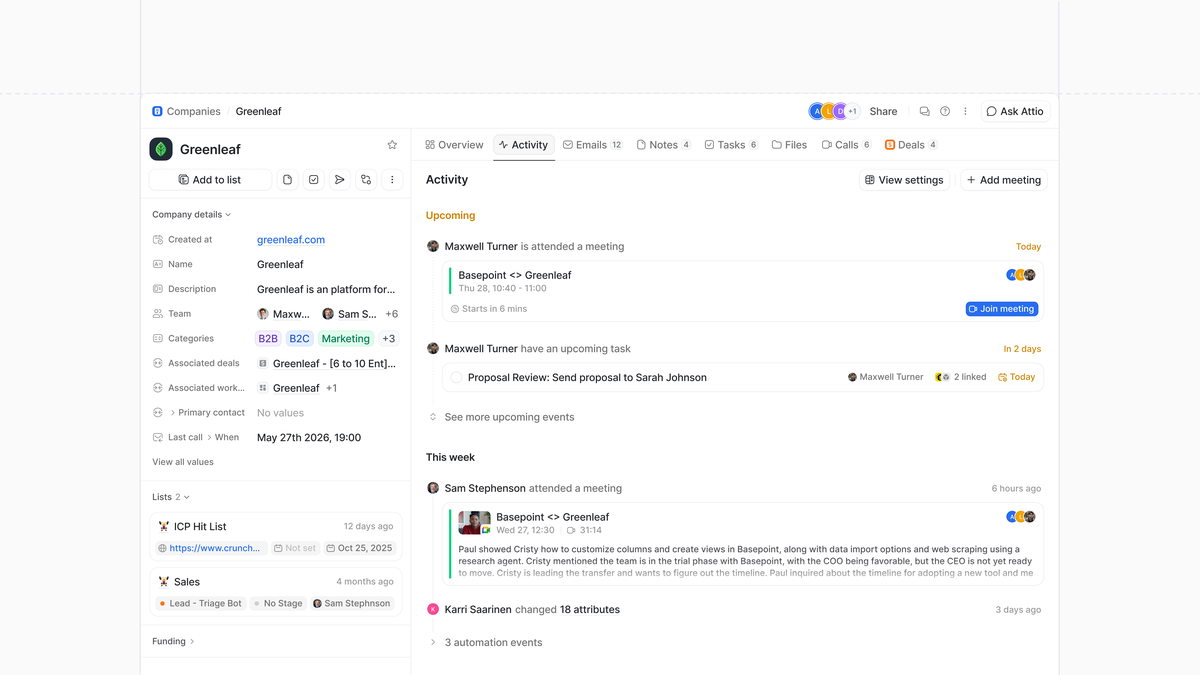
Attio review: current Plus, Pro and Ultra pricing per workspace, how AI credits are spent, plan gates, export limits and who should pick Pipedrive or HubSpot instead.
Table of Contents
A year ago Attio sold itself as the flexible CRM: build your own objects and relationships, and stop forcing a startup's sales motion into Salesforce's shape. That still holds. But through 2026 the London company has rebuilt the product around agents, and it has changed what it charges. The homepage now opens with "Welcome to agentic revenue". Every AI action draws on a pool of credits, and the price is a base fee per workspace plus a fee per extra user.
That second change is why this review exists. Most comparison pages still quote Plus at $29 and Pro at $69 per seat. Those numbers are out of date. Pricing below was checked on attio.com/pricing on 13 November 2026, and the page carries no "last updated" date, so check it again before you sign.
Attio was founded by Nicolas Sharp (CEO) and Alexander Christie (CTO). It raised a $52M Series B led by GV in August 2025 and has raised $116M in total. Its homepage claims more than 30,000 customers, with OpenAI, Granola, Railway and Modal among the logos. Those are Attio's figures, not ours.
There are four plans. Free costs nothing for up to three users and includes 50,000 records, 3 objects, Ask Attio, enrichment, workflows and email and calendar sync. Plus is $40 a month per workspace billed annually ($50 monthly), and that includes one user. Each extra user is $35 a month annually ($44 monthly). Plus stops at 10 users. Pro is $100 per workspace annually ($125 monthly) with one user included, then $79 per extra user ($99 monthly), with no user cap. Ultra is $1,000 a month, billed annually only, and includes five users. Each user after that is $189.
Ultra replaced the Enterprise plan for new workspaces in November 2026. If a sales rep says "Enterprise", they mean a legacy plan.
| Team size | Plus (annual) | Pro (annual) | Ultra (annual) |
|---|---|---|---|
| 1 user | $40/mo | $100/mo | $1,000/mo |
| 5 users | $180/mo | $416/mo | $1,000/mo |
| 10 users | $355/mo | $811/mo | $1,945/mo |
Paying monthly costs about 25% more: five users on Pro is $521 a month instead of $416. For that same team the old $69-per-seat rate came to $345, so the move cost a five-person Pro team about $71 a month. The base fee is a small premium on top of the user price: $5 a month on Plus and $21 on Pro.
Two discounts are worth knowing. Every new workspace gets a 14-day Pro trial with no card required, and you can drop to Free when it ends. Venture-backed startups with up to 10 users get 80% off annual Pro and credits for the first year and 30% off the second. You have to apply within 90 days of creating the workspace, so ask before the trial runs out.
Every user gets Ask Attio credits: 100 on Free, 500 on Plus, 1,000 on Pro and 2,500 on Ultra. On top of those the workspace gets a shared pool of 250, 1,500, 10,000 or 20,000. Ask Attio spends the user's credits first and then dips into the shared pool, unless an admin sets a limit.
Attio gives example costs. "Prep me for my next meeting" takes 10 to 20 credits. A daily briefing takes 30 to 50. Finding every customer who asked for a feature and drafting an email to each takes 50 to 80. A rep who runs a briefing every working day will spend most of a Plus allowance on that alone.
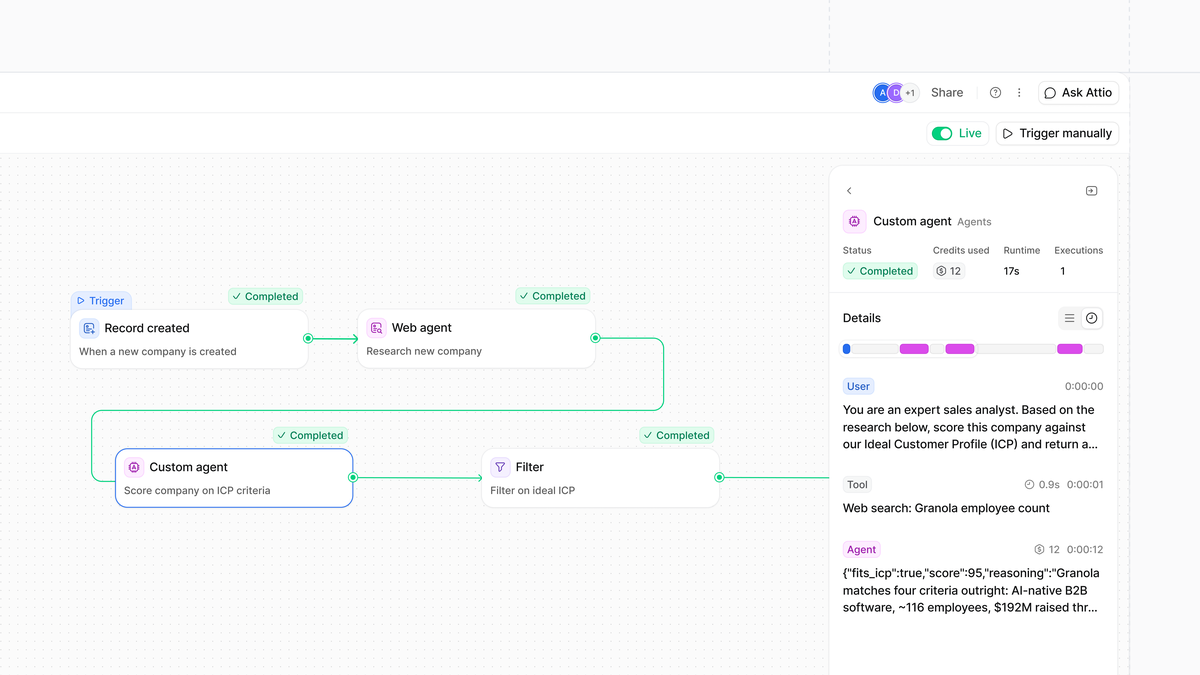
AI attributes are the ones to watch. They are charged per record every time they recalculate. Summarize, Classify and Prompt completion cost 1 credit each; the Web agent costs 10. Run the web research agent across 1,000 companies and you have spent 10,000 credits, which is Pro's whole shared pool, and it bills again the next time the column recalculates. Extra credits come in packs: 5,000 for $70 a month annually ($85 monthly), up to 50,000 for $475 ($595).
In workflows, triggers, conditions, delays and lookups are free. Record writes, sequence enrolments, HTTP calls and integration blocks cost 1 credit each. Agent, code and SQL blocks are billed by tokens, so you only learn their price by running them. Since September the agent log shows the credits each run used. Attio's own screenshot shows an ICP-scoring agent taking 12 credits in 17 seconds. Watch that log during the trial before you trust a workflow with your whole inbound flow.
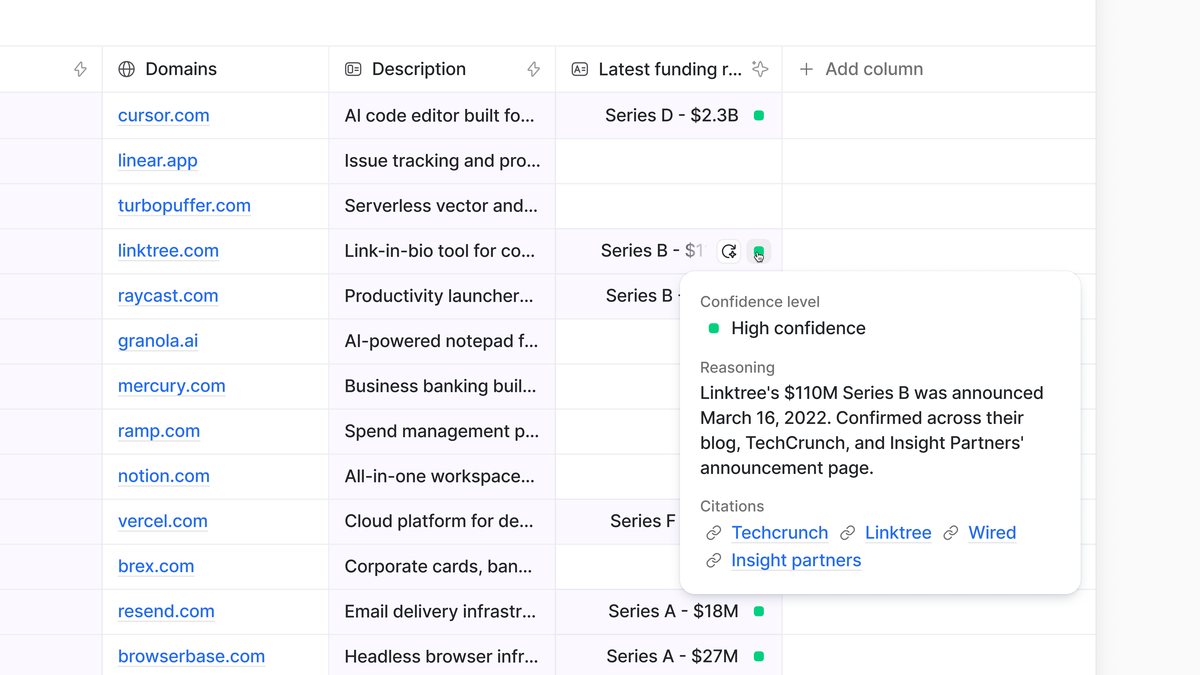
Ask Attio launched in February as a chat window over your calls, emails and records. In April it started acting. You can ask it to send a follow-up, move a stalled deal or create a task after a meeting. It shows each proposed change and waits for you to approve it before anything is written. That approval step is the right default for a tool that edits your pipeline. It works in the app and from Slack.
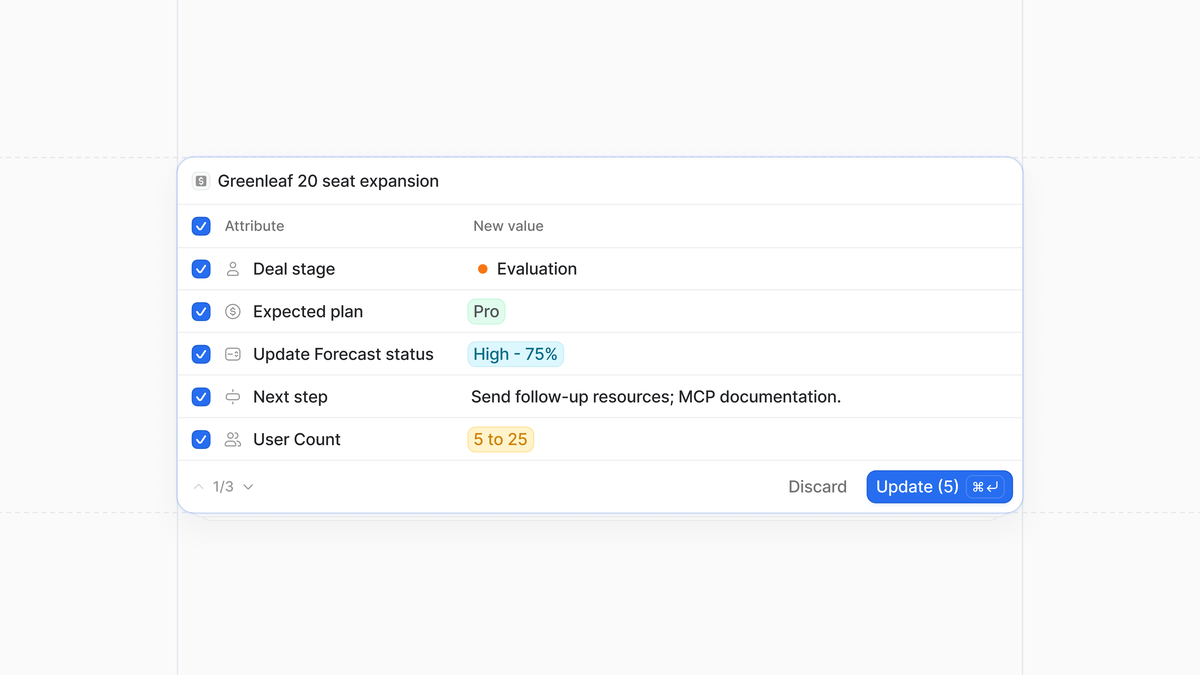
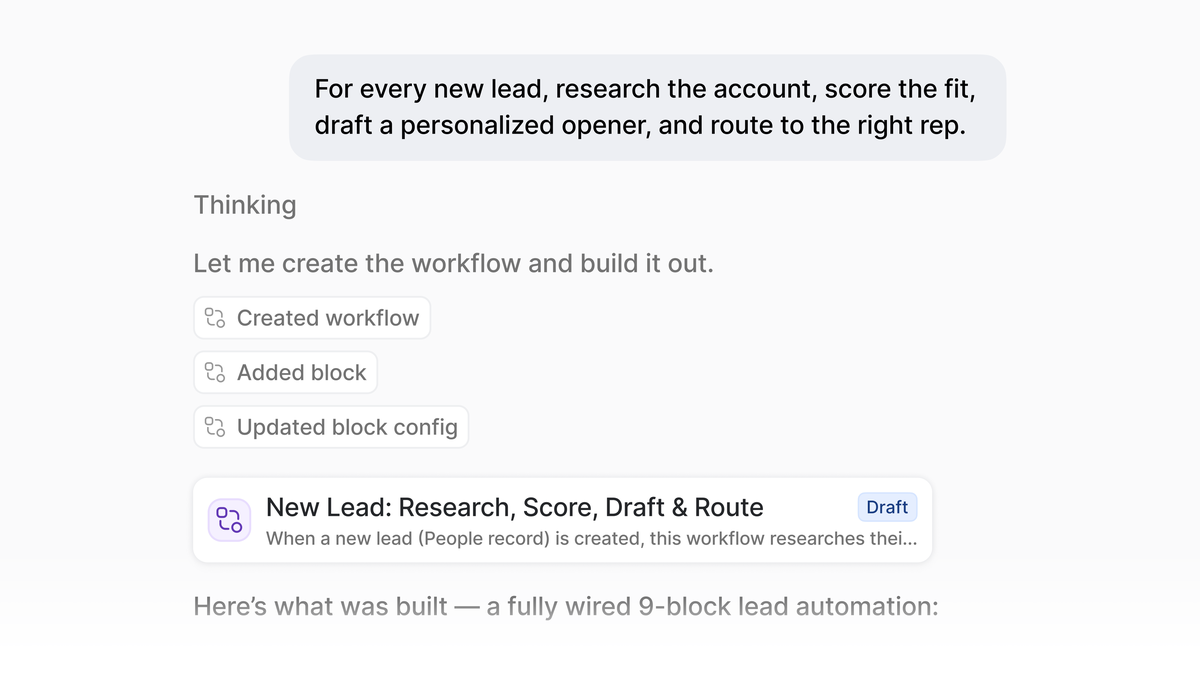
The rebuilt Workflows arrived on 9 June. You describe the automation in a sentence and Attio builds the blocks: a web agent to research a new account, a custom agent to score it, a draft opener, routing to a rep. Notion, Linear and Fin plug in as native blocks or through MCP. That is quicker than wiring the same thing up in Zapier. The cost is that every agent step is a variable credit charge, as the section above shows.
In October Attio added a SQL engine, a read-only Postgres-compatible endpoint called Data Connectors, and a new Activities data type for touchpoints such as tickets and product events (still in beta). Read the plan gates closely. SQL questions inside Ask Attio work on every plan. SQL through the API, MCP and Workflows, and Data Connectors, are on Ultra only. The REST API and the MCP server are on every plan, with published limits of 100 reads and 25 writes per second.
All members of a workspace must be on the same plan. You cannot put three ops people on Pro and the rest of the team on Plus, so the plan your most demanding user needs is the plan everyone pays for.
Custom objects, sequences, Call Intelligence and team permissions all need Pro. Plus also limits each user to 1,000 sent emails a month and 15 reports. SSO, SCIM, audit logs and admin-only exports need Ultra, or Pro plus the Governance add-on at $30 per user a month, billed annually. For a 20-person team that wants SAML on Pro, that is $600 a month on top of the plan.
Extra records on Pro and Ultra cost $240 a month per million, billed annually. Objects beyond Pro's 12 cost $400 a month each. Few small teams will reach those numbers, but a team that enriches every website visitor into the CRM can.
Getting in is easy. Plus, Pro and Ultra include free migration through Import2 from HubSpot, Pipedrive and Salesforce. From Salesforce it moves contacts, accounts, leads and opportunities, but not Cases, so a support history stays behind. CSV import works on every plan.
Getting out is harder than it looks. Any view exports to CSV or Excel, and admins on every plan can download a full workspace backup as a zip of CSVs. But Attio's help center says synced emails cannot be exported, and enriched cells come out blank. Meetings and call recordings are only available through the API. If you leave after two years, your email history and every enriched company field stay in Attio. Plan for that before you let it become the only copy.
Chat and email support come with every paid plan. Priority support is on Pro and Ultra. It runs 24 hours a day, Monday to Friday, and Attio says first replies typically arrive within an hour during office hours. There is no published SLA. Ultra adds forward-deployed onboarding.
On G2 Attio averages about 4.3 out of 5 from around 500 reviews. The complaints that come up most are integrations and note or email sync misbehaving, and the cost of larger teams that need a lot of workflow capacity. Capterra's sample is small, eight reviews at 3.8, with support scored lower than the rest. These are summaries of the review platforms, not results from our own testing.
Attio is the best-designed CRM for a B2B startup that wants its own data model and AI agents inside the CRM, not bolted on. If you are venture-backed with ten people or fewer, apply for the 80% discount and Pro becomes cheap for a year. Pro is the real plan. Plus loses custom objects and sequences, which are the reasons to choose Attio in the first place.
Skip it if you only need a pipeline and price matters most. Five users on Pro is $416 a month before any credit packs, and Pipedrive or folk will run a deal board for far less. Skip it if you want marketing automation in the same tool, which is HubSpot's ground. And skip it if you need support case management at Salesforce scale. Cases do not even migrate. For more options, see our CRM roundup.
Visit the official website to see the latest plans, pricing, and special offers.
Get Started - Attio* Affiliate link - we may earn a commission at no extra cost to you.