Better Stack Review: Uptime, On-Call, Logs and Status Pages on One Bill
Better Stack review: responder pricing, EU vs US vs Singapore telemetry costs, status-page add-ons, the logging spending-limit trap, Sentry-compatible errors and who should skip it.
Expert Review

Table of Contents
What one bill replaces
Most small SaaS teams end up paying five vendors to learn that their site is down: an uptime pinger, a paging tool, a hosted status page, somewhere to put logs and an error tracker. Better Stack sells all five under one login, and the part that makes it unusual is how it charges for them. Viewers are free and unlimited. You pay a licence only for the people who get woken up, and then you pay for telemetry by the gigabyte, at a price that depends on which data region you pick.
That model is cheap when three engineers share an on-call rotation and a twenty-person company just wants to look at dashboards. It gets expensive in three specific places, covered below: status-page add-ons, the Singapore region, and log volume during an incident. We did not run a paid account; every figure comes from Better Stack's pricing page and docs, checked on September 30, 2026.
Pricing: what a small team actually pays
The free plan gives you 10 monitors and heartbeats, one status page, Slack and email alerts, 100,000 exceptions a month, 5,000 session replays, 3 GB each of logs and traces kept for 3 days, and 30 GB of metrics. Phone and SMS alerts are not on the list. Neither is a check interval faster than 3 minutes.
The paid unit is the responder licence: $34 a month, or $29 billed annually. Each one includes uptime monitoring, incident management, on-call scheduling, status pages and unlimited phone calls and SMS. There is no seat minimum.
| Item | Monthly billing | Annual billing |
|---|---|---|
| Responder licence | $34 | $29 |
| 50 extra monitors | $25 | $21 |
| 10 extra heartbeats | $20 | $17 |
| Extra public status page | $15 | $12 |
| Slack / Teams incident management | $9 per responder licence | |
| Telemetry bundle "Nano", EU region (40 GB each of logs, traces, metrics) | $30 | $25 |
| Dedicated call-routing phone number | $250 | $208 |
A worked example. Three engineers on annual billing cost 3 × $29 = $87 a month. Add the EU Nano bundle at $25 and you are at about $112 a month for 30-second uptime checks, on-call with unlimited phone and SMS, one status page, and 40 GB each of logs, traces and metrics with 30-day log retention. On monthly billing the same setup is $102 + $30 = $132. A 60-day money-back guarantee applies.
Region is the multiplier people miss. The same Nano bundle is $38 a month (annual) in the US and $88 in Singapore, three and a half times the EU price. EU (Germany) is both the default and the cheapest, so an Asia-based team that wants its data close to home pays for it.
Uptime checks and on-call
Paid monitors check as often as every 30 seconds. Free ones check every 3 minutes, which means an outage can run for several minutes before anyone hears about it. Heartbeat monitors, the kind a cron job pings to prove it ran, resolve down to one second.
False alarms are handled by quorum. Each monitor is checked from at least four locations, and an incident opens only after three of them fail. Sensible, though Better Stack does not publish how many probe locations it runs in total.
Escalation policies, schedules and phone alerts live in the same product, and the phone alerts are what the licence really buys. A PagerDuty-style rotation with unlimited calls and SMS inside a $29 seat is the strongest part of the offer. The weak spot is scale: a Capterra reviewer called it ideal for a few sites but clumsy past 100, and adding monitors in blocks of 50 at $21-$25 adds up for agencies watching hundreds of client sites.

Status pages: cheap to start, pricey to brand
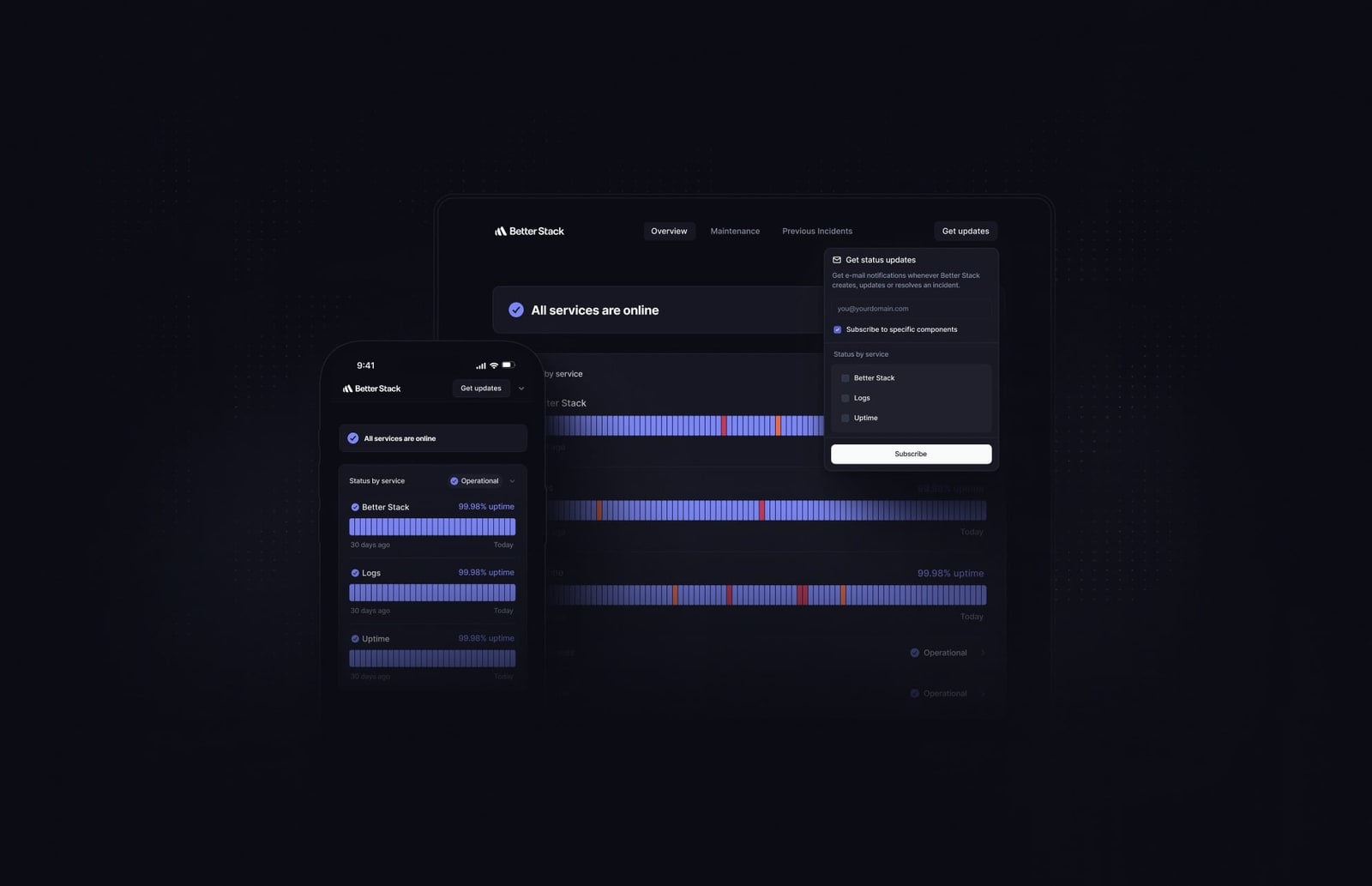
The first public status page is included, with 1,000 subscribers. Extra pages are $12-$15 a month. The trouble starts when a customer asks for a status page that looks like your product rather than Better Stack's. Custom CSS and JS is $12-$15 per page, password protection $42-$50, and white-labelling is $208 a month annual or $250 monthly, per page. IP allowlisting, SSO and sending subscriber emails from your own domain are $208-$250 each.
Put another way, one white-labelled status page costs more than seven responder licences. A B2B company that needs a private, branded page for each enterprise customer should price that line before anything else.
Logs, traces and metrics
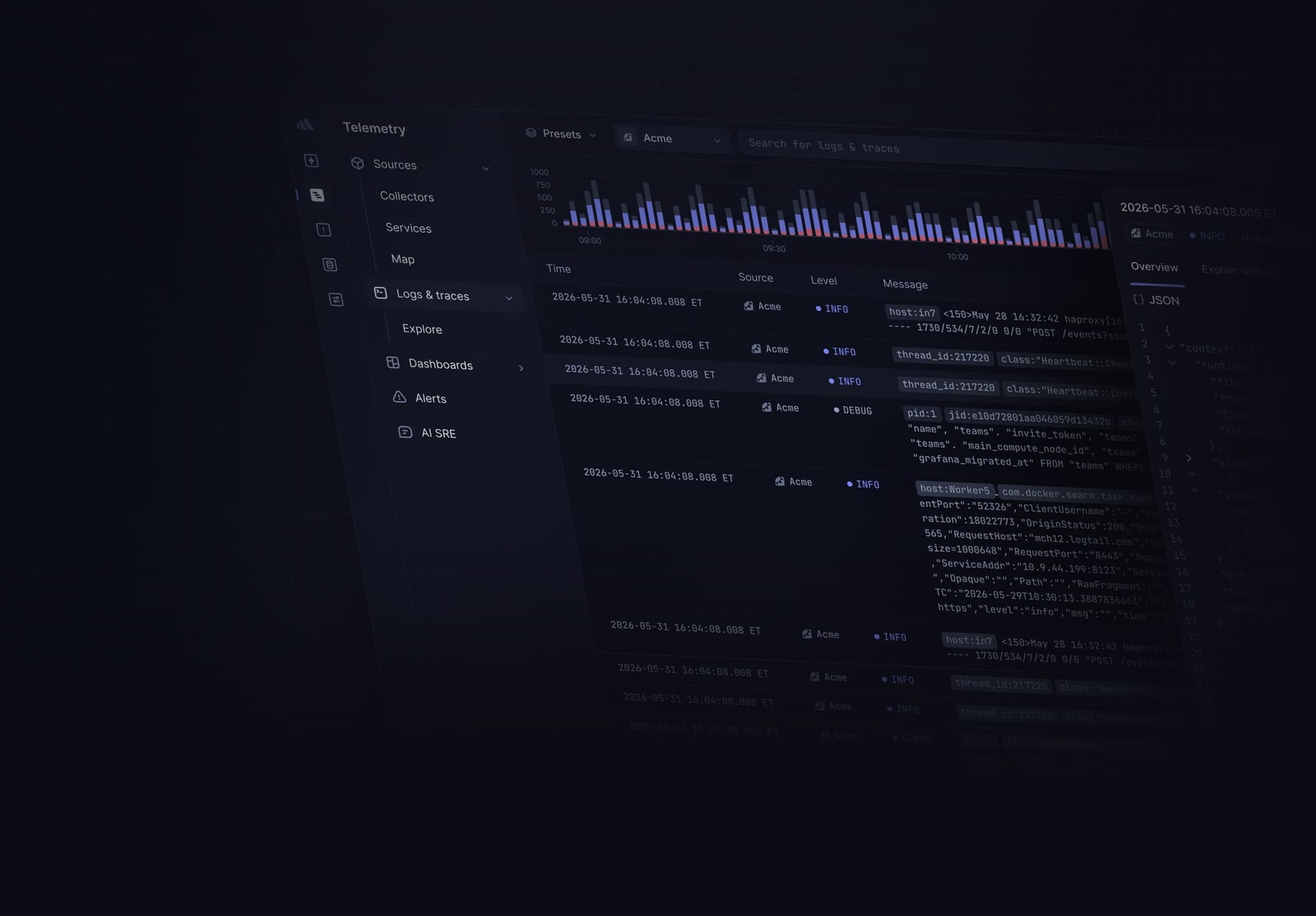
Outside the bundles, telemetry is pay-as-you-go. Log and trace ingestion costs $0.10 per GB in the EU, $0.15 in the US and $0.35 in Singapore, plus retention at $0.05, $0.08 or $0.18 per GB per month. Data arrives through Better Stack's collector, OpenTelemetry or Vector, and is queried with SQL, PromQL or the HTTP API.
The detail worth knowing before an incident is the spending limit. Set one and the bill is safe, but Better Stack's own docs warn that it will "completely stop processing your data once you hit the limit", and ingestion starts answering with a 402 error. A bad deploy that floods your logs is exactly when you hit the cap, and exactly when you need those logs. Leave headroom, or accept the bill.
Metrics changed billing in 2026. New accounts and new metrics sources pay for retained data by the GB: $0.50 per GB per month in the EU, $0.75 in the US, $1.75 in Singapore, with 30 GB free and roughly 1,000 time series per GB. Older accounts can stay on the legacy data-point plan, and moving off it is one-way. Better Stack's own billing doc concedes that some existing customers would pay more under the GB model. The caution has history: in October 2024 Better Stack publicly apologised to a customer over a surprise $35,000 monthly metrics bill.
Leaving is easier than with most hosted log tools. For $208-$250 a month, Better Stack will store your data in your own S3, Cloudflare R2 or DigitalOcean Spaces bucket, in ClickHouse Native format that you can query with clickhouse-local, and the files can stay after your retention period ends. You have to choose this when you create the source, because it cannot be switched later. Competitor OneUptime calls the log management "relatively basic compared to dedicated tools", and teams that need deep APM should look at Grafana Cloud instead.
Error tracking against Sentry
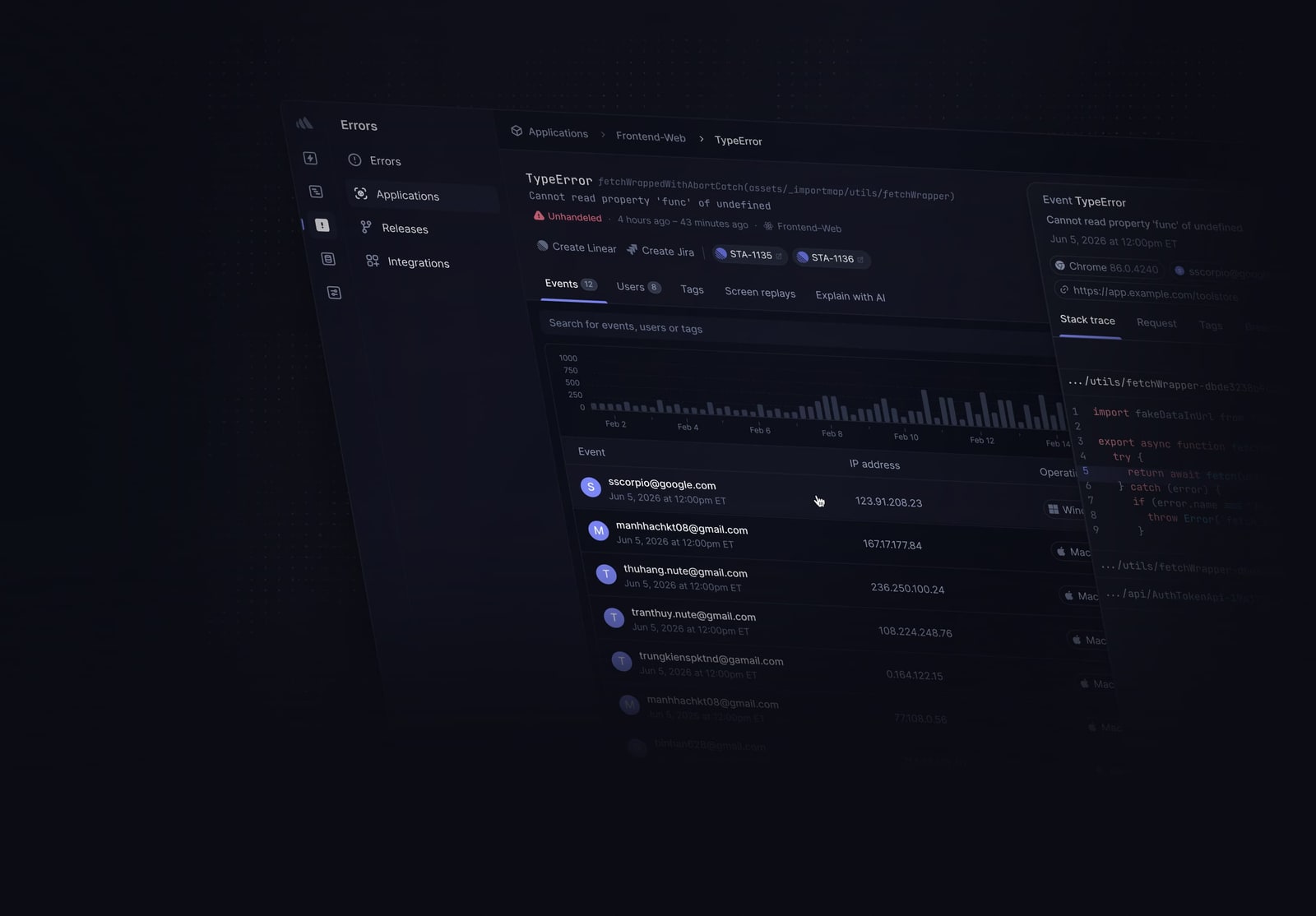
The error tracker accepts the Sentry SDK, so switching means changing a DSN rather than re-instrumenting your code. Better Stack markets it as "Sentry-compatible at 1/6th the price", a figure based on its own comparison of Sentry's Business on-demand rate of $0.0003 per event against its EU rate of $0.00005.
Taken at face value, one million exceptions a month costs 900,000 × $0.00005 = $45 on Better Stack's EU region, after the free 100,000, or $67.50 in the US. That is Better Stack's framing, and Sentry's plans include event quotas that shrink the real gap. Our Sentry review covers what you give up: Sentry's release health, performance tooling and issue grouping are more mature. Errors are kept for 90 days.
The AI SRE and MCP server
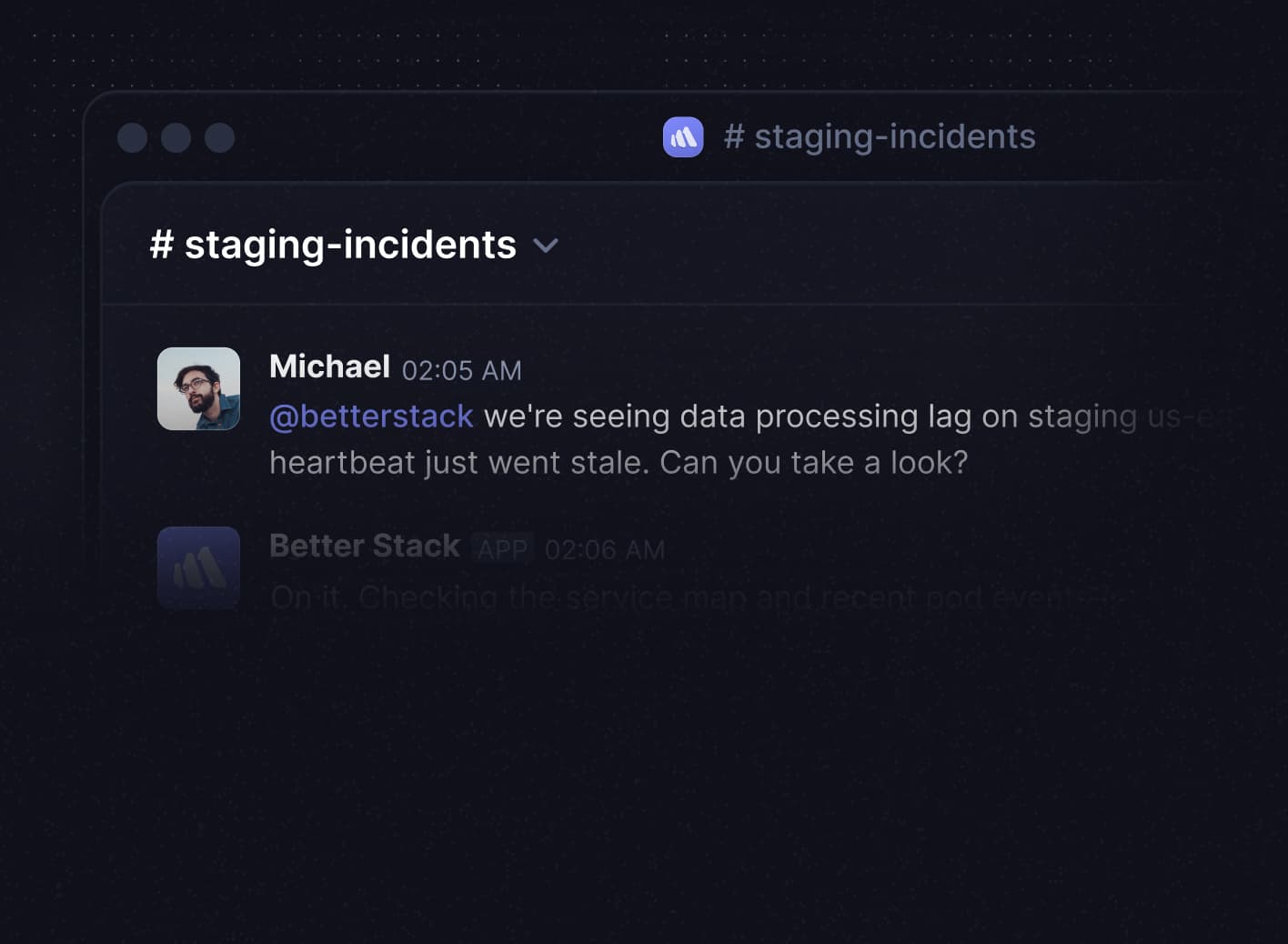
The newest piece is an AI agent you tag as @betterstack inside Slack or Microsoft Teams. It reads across logs, metrics, traces, errors and web events, builds a service map with eBPF and OpenTelemetry without code changes, and suggests a root cause for a human to approve. It can also open a GitHub pull request for a new exception. It is billed at $5 per million tokens.
The August 2026 changelog added dashboards built from a plain-English prompt. The same data is reachable from Claude Code, Codex and other agents through the MCP server Better Stack launched in September 2025. Useful, but it is one more metered line on the bill.
Compliance, data location and support
Data is stored in EU data centres by default, certified to ISO/IEC 27001, and Better Stack is SOC 2 Type 2 compliant. It is not HIPAA compliant, so health-data teams are ruled out. It is SaaS-only, with no self-hosted option. Better Stack, Inc. is a Delaware corporation, founded in 2021 with $28.6M in funding and much of its team in Prague.
No per-plan support response time is published anywhere we could find. A Software Advice reviewer found the live chat slow to respond. On Capterra, where Better Stack holds 4.8 out of 5 from 37 reviews, the recurring complaint is the step from free to paid, which several reviewers call steep for a small business.
Verdict: who should buy it, and who should not
Buy it if you are a small or mid-sized SaaS team that wants uptime checks, a real on-call rotation with phone alerts, a public status page and logs in one place, and you are happy with EU hosting. For about $112 a month, three engineers get what would otherwise take separate uptime, paging, status-page and logging subscriptions, and the rest of the company views it for free.
Skip it if you only need cheap uptime pings: UptimeRobot starts around $7 a month. Skip it if you need HIPAA, self-hosting or deep APM, where Grafana Cloud or Datadog fit better. And price it carefully if your customers expect branded, private status pages, because at $208 a page that line can outgrow everything else on the invoice.
Ready to try Better Stack?
Visit the official website to see the latest plans, pricing, and special offers.
Get Started - Better Stack* Affiliate link - we may earn a commission at no extra cost to you.