Funnel.io Review: The $300 Starter Plan and What Flexpoints Really Cost
Funnel.io review: Starter from $300/month and Business from $600 billed annually, plus flexpoints that expire. Rate card math, contract terms, support hours and cheaper alternatives.
Expert Review

The $300 is a plan fee, not the bill
Funnel's pricing page shows three numbers, and one of them is misleading. Starter "starts from $300 / month, billed annually", Business from $600, and Enterprise is a sales call. None of those figures tells you what you will pay, because Funnel charges in two layers: the plan, and a prepaid pot of capacity it calls flexpoints.
Every connector, account and destination you switch on draws from that pot. The rate card on the pricing page, checked on October 20, 2026, reads 50 flexpoints (FP) per connector, 5 per ad account, 150 per visualisation destination such as Looker Studio or Google Sheets, 300 per warehouse destination such as BigQuery or Snowflake, and 50 per conversion API. Every plan needs at least 400 FP, topped up in bundles of 100. What a bundle costs varies by tier and is published nowhere. Neither is the number of flexpoints the $300 actually buys.
Funnel can't quite decide what flexpoints are. The pricing page says they are "part of your contract, not a usage meter". The help centre article updated on September 11, 2026 calls it "a usage-based model" in which "you pay for exactly what you use". The terms settle the argument: flexpoints "expire at the end of the Subscription Period, cannot be reduced or refunded during a Subscription Period, nor rolled over". That is prepaid annual capacity. Points you don't use are money already spent.
One part of the model does work in your favour. Funnel does not charge by data volume or row count, and pulling five report types from one Google Ads account costs the same as pulling one.
Working out your flexpoints
Here is a common in-house or small-agency setup, priced from the published rate card. It is arithmetic, not a quote.
| Item | Rate | Flexpoints |
|---|---|---|
| Google Ads connector | 50 FP | 50 |
| Meta Ads connector | 50 FP | 50 |
| Google Analytics 4 connector | 50 FP | 50 |
| 10 ad accounts | 5 FP each | 50 |
| Looker Studio destination | 150 FP | 150 |
| Total | 350 |
350 FP sits under the 400 minimum, so you pay for 400 and keep 50 spare - room for one more connector. The picture changes the moment the data needs to reach a warehouse. Swap Looker Studio for BigQuery at 300 FP and the same setup needs 500 FP: the minimum plus one bundle at an unpublished price. BigQuery also isn't a Starter destination. It arrives with Business, so the warehouse move takes you from the $300 tier to the $600 tier before the extra bundle is even counted.
The September 2026 rate-card changes help a little. Custom connectors dropped from 100 FP to 50. The help centre now lists data sources at 0 FP, down from 5, while the pricing page still shows 5 per account, so ask which one your contract uses. If the help centre is right, the ten accounts above are free and the Looker Studio setup falls to 300 FP. Google Sheets as a source is now charged 10 FP per workbook rather than per tab, which removes one of the billing complaints users repeated most.
Starter, Business and Enterprise
Every plan includes unlimited users, unlimited Funnel AI usage and the MCP integration that lets Claude or ChatGPT query your data. The differences are reach and frequency.
| Starter | Business | Enterprise | |
|---|---|---|---|
| Starting price | $300/month, billed annually | $600/month, billed annually | Custom |
| Connectors | 117 | 579 | 590 |
| Destinations | 13 | 46 | 47 |
| Workspaces | 1 | Unlimited | Unlimited |
| Client portals | 1 | Unlimited, custom branding | Unlimited, custom branding |
| Scheduled exports | Daily | Every 2 hours | Every 2 hours |
| Cloud warehouses | No | BigQuery, Amazon S3 and more | Adds Snowflake |
| Power BI and Tableau | No | Yes | Yes |
| Single sign-on | Google only | Google only | SAML, OIDC, SCIM |
| Support | In-app | Priority in-app | Priority in-app plus SLA |
Agencies hit the single Starter workspace first. Every client's data shares one space, and the one client portal can't carry your branding. Daily scheduled exports matter too, if a client expects this morning's spend on the dashboard before lunch.
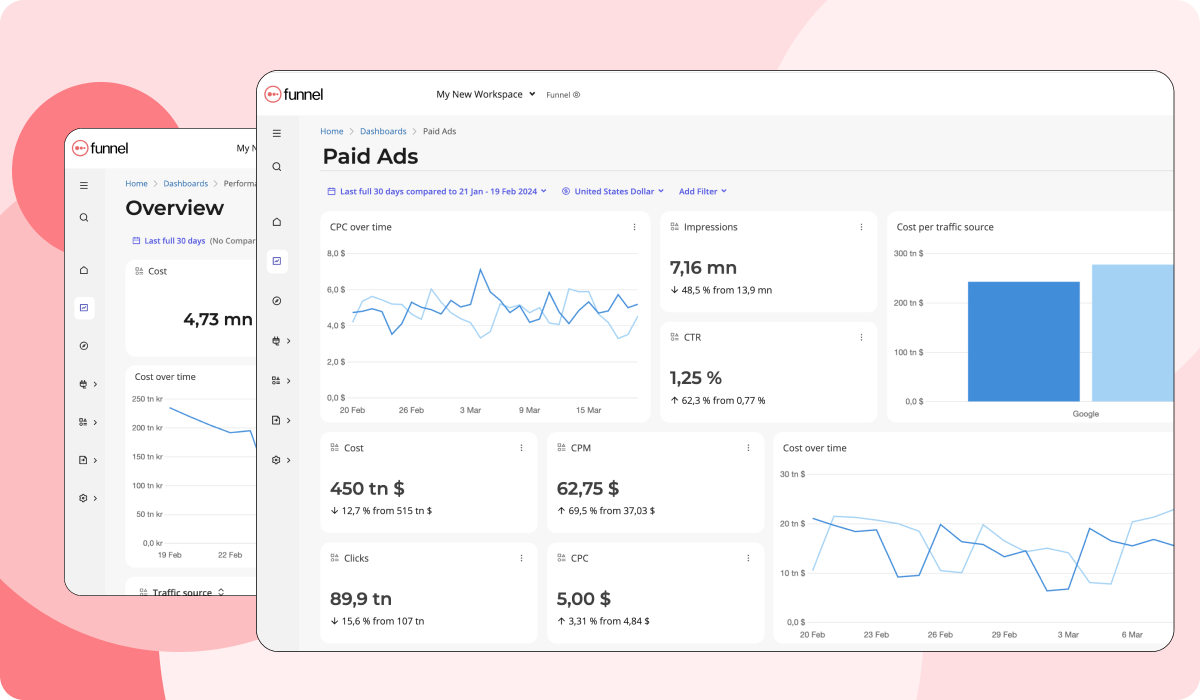
Don't buy on connector count. Funnel's own site gives at least four totals: "more than 600" on the homepage, 640 on the connectors page, 590 in the plan table and "500+" in the Business blurb. What matters is whether your specific sources are among the 117 Starter covers. The 30-day trial needs no card, so check that before you talk to sales.
What you get for the money
Funnel is not a pipe that streams rows from Meta straight into your sheet. It downloads each source on a schedule, stores its own copy, maps the fields so spend from Google Ads and spend from Meta land in one column, and serves that copy to every destination you connect. Most sources import several times a day, a few once a day, and the first sync usually reaches back two years where the platform allows it.
That hosted, cleaned copy is the real product. It is why one connector can feed Looker Studio, a warehouse and Power BI at the same time without three sets of field mappings. On top of it sit Funnel AI, which answers questions about your data in plain English, and the MCP connector, which hands the same data to Claude or ChatGPT. Both come with every plan and no usage cap. Improvado, for comparison, sells an MCP-only tier for $100/month.

Funnel Measure is a separate bill. It adds media mix modelling, multi-touch attribution and incrementality testing, sold only as an add-on to Business or Enterprise. The pricing calculator puts Digital Measurement at $2,250/month, billed annually, for a brand spending $500K-$1M a month on ads. Advanced Measurement, which adds offline media, a media planner and budget optimisation, is quote-only.
The contract, and getting out
Funnel's terms, last updated on September 11, 2025, say the service "is non-cancellable and all fees are non-refundable". The subscription renews automatically unless you give notice at least 30 days before the term ends, and Funnel may raise its fees at each renewal.
Only Starter customers can cancel inside the app. Business and Enterprise customers have to contact support, inside the same 30-day window. Miss it and you have bought another year of flexpoints that expire whether you use them or not. Put the date in a calendar on the day you sign.
Leaving is otherwise clean. You can export your data to another provider at any time during the term, Funnel charges no switching fee, and after the term ends the data stays retrievable on request for 30 days before it is deleted. Exports already written to BigQuery or S3 stay put when you remove them. Snowflake is the exception to know before you pick a destination. Funnel shares tables it hosts itself, and they disappear when the export is deleted or 30 days after it is disabled. If Snowflake is your warehouse, copy those tables into your own schema, or you do not own a copy at all.
Who runs it and how support works
Funnel AB is a Stockholm company, founded in 2014 by Fredrik Skantze, its CEO, and Per Made. It has more than 300 staff across Stockholm, Boston, Hamburg and Sydney, and it bought the attribution company Adtriba. It claims over 3,000 mid-market and enterprise customers, with Samsung, Trivago, Skyscanner and Sony among the logos, $80 billion of ad spend processed a year and 99.99% average uptime over the past year.

Support is in-app chat on every plan, "priority" from Business up, and a contractual SLA covering response, repair times and uptime on Enterprise only. Funnel's own support guide sets the expectations plainly: your first reply may come from a bot, and the team works Monday to Friday in office hours. A connector that breaks on a Saturday waits until Monday, so a weekend campaign report built on Funnel needs a fallback.
The complaints users repeat, as summarised by Whatagraph and Porter Metrics (both competitors, so read them with that in mind), are a flexpoint model that feels confusing and expensive, surprise bills, a learning curve with little in-app guidance, and occasional gaps in imported data.
Funnel vs Supermetrics, Windsor.ai and Fivetran
Supermetrics is the comparison most buyers make, and on price it isn't close. Its Starter plan is from $39/month billed yearly ($49 monthly), Growth from $159/month. The cheaper plans pull data into Sheets or Looker Studio when the report refreshes, so the cleaning and cross-channel mapping happen on your side. Our Supermetrics review covers where that approach runs out.
Windsor.ai is cheaper still, with a forever-free tier after its 30-day trial and Basic at $19/month billed annually. Fivetran suits teams that already run a warehouse and only want raw pipelines; it bills on monthly active rows, and the free plan covers 500,000 of them. If what you really need is client-facing reports rather than a data layer, AgencyAnalytics is built for that job.
Verdict
Buy Funnel if you are a mid-market brand or an agency with dozens of ad accounts feeding several destinations at once: Looker Studio for clients, BigQuery for analysts, Power BI for finance. Business is the plan that makes sense, with unlimited workspaces, two-hourly exports and warehouse destinations. The hosted, mapped history is worth paying for when the alternative is maintaining those mappings yourself, and Measure adds MMM on the same data if your ad spend can carry $2,250 a month.
Skip it if you need three sources in Looker Studio or Google Sheets. You would pay at least $300 a month, a year up front, for capacity that expires. Supermetrics does that job from $39 and Windsor.ai from $19. Whoever signs, write down the renewal date minus 30 days. After that day, next year is already paid for.
Ready to try Funnel?
Visit the official website to see the latest plans, pricing, and special offers.
Get Started - Funnel* Affiliate link - we may earn a commission at no extra cost to you.