Mailtrack Review: Free Unlimited Gmail Tracking, With the Useful Data Behind the $19.99 Plan
Mailtrack review: free unlimited Gmail open tracking, but group-email and link-click data need the $19.99 Mailsuite plan. Plans, accuracy and privacy checked.
Expert Review

The catch: tracking is free, the data is not
Mailtrack sells itself in one line on its Chrome Web Store listing: free, unlimited read receipts for Gmail. That line is accurate. Install the extension and every email you send from Gmail gets a tracking pixel, and your Sent folder grows check marks: one means unread, two means read. There is no volume cap of Mailtrack's own, no card at signup and no expiry date on the Free plan.
What the listing leaves out is where the paywall sits. It is on the data. Free records every open but shows you only the first one. The same listing sells per-recipient tracking in group emails as a headline feature, and per the pricing table that is only on the most expensive plan. So does click notification. "Unlimited tracking" is true. "Unlimited information about what happened" costs $19.99 a month.
A naming note before the numbers, because the vendor makes this confusing. The company is Mailsuite S.L., based in Barcelona and building the extension since 2013. "Mailtrack" is the extension and also the $6.99 middle plan. "Mailsuite" is the $19.99 top plan. On 2 November 2026 the store listing showed 3,000,000 users and 4.2 stars from 11.8K ratings. Mailtrack's own site still says 4.4.
How much a double check mark actually tells you
An "open" in Mailtrack means one thing: the recipient's mail client downloaded a tiny image. Mailtrack's help centre says that happens because the main recipient opened the email about 95% of the time, and adds that it "will never be 100% reliable". The exceptions are worth knowing before you act on a check mark.
Outlook doesn't load images by default, and Yahoo and Protonmail often don't display them, so a real read can show as unread. Plain-text emails can't be tracked at all. The opposite error is more common in business mail. Firewalls, antivirus scanners and some mobile apps pre-fetch email content, and inbox preview panes fire the pixel too, so a "read" can be a machine. If your recipient forwards the email, every open by the new readers is credited to them. Mailtrack also stopped reporting the device an email was opened on, citing the way Gmail proxies images.
One sensible default: emails you send to yourself aren't tracked, so testing your own message doesn't create a false read.
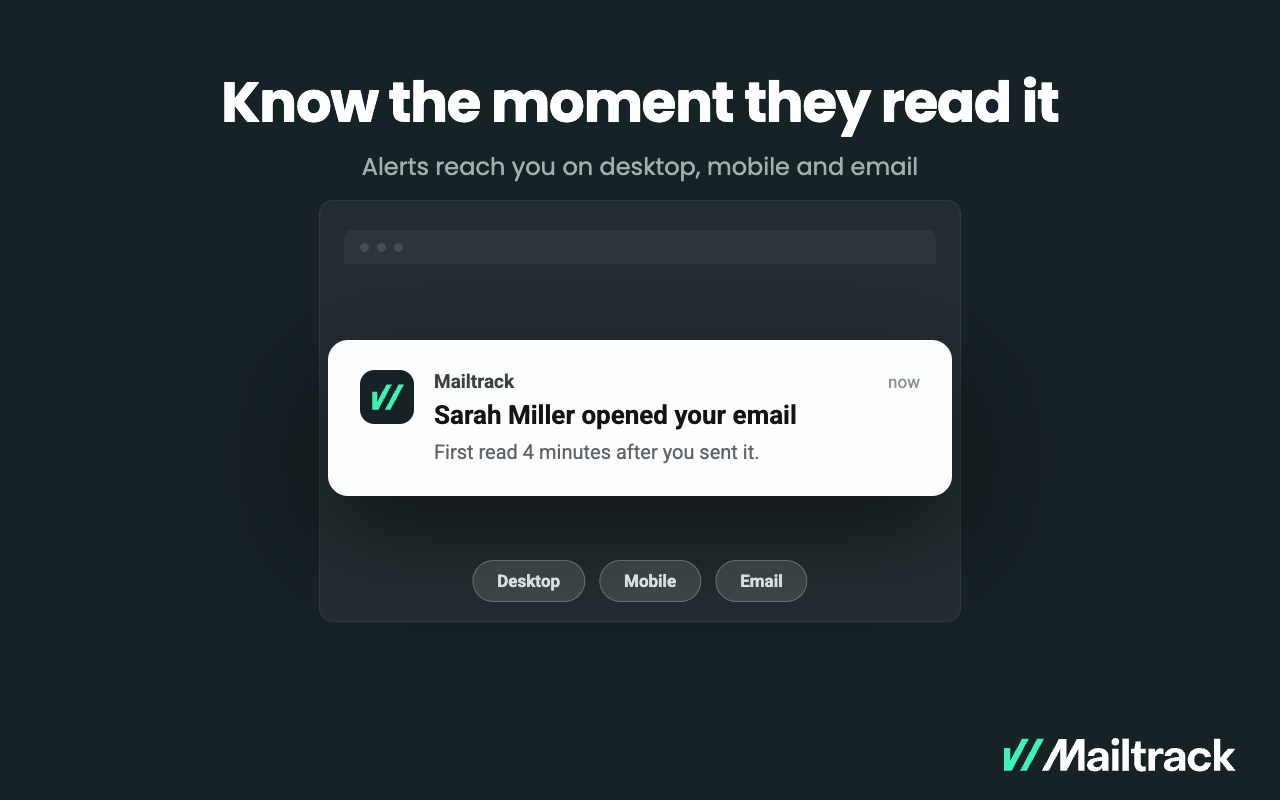
Treat the signal as "probably seen", never as proof. It is useful for deciding when to follow up. It is not evidence that a client read a contract.
Pricing: three plans, all billed per user per month
These are the prices a US visitor saw on Mailsuite's pricing page, checked on 2 November 2026. Checkout is monthly. The page shows no annual price, although the help centre says yearly billing costs less. Tax may be added at checkout. The older Pro and Advanced plans are closed to new users.
| Free | Mailtrack | Mailsuite | |
|---|---|---|---|
| Price | $0 | $6.99 | $19.99 |
| Tracked emails | Unlimited | Unlimited | Unlimited |
| Open history shown | First open only | Last 7 days | Full history |
| "Sender notified by Mailtrack" signature | On (removable per email) | Off | Off |
| Who opened a group email | No | No | Yes |
| Link-click data | 10 emails | 10 emails | Unlimited |
| Click and PDF-open notifications | No | No | Yes |
| Open alerts by email | No | No | Yes |
| Scheduled sending | No | No | Yes |
| Campaign sending | 100 emails | 100 emails | 60k emails/month |
| CRM auto-BCC, Zapier | No | No | Yes |
Look hard at the middle column. For $6.99 you get the signature removed by default and seven days of open history. Free users can already strip the signature from any single email with a "Remove signature" click, and the email is still tracked. So the Mailtrack plan is roughly $84 a year for one saved click per email and a week of repeat-open data. For most people that is the worst value on the page.
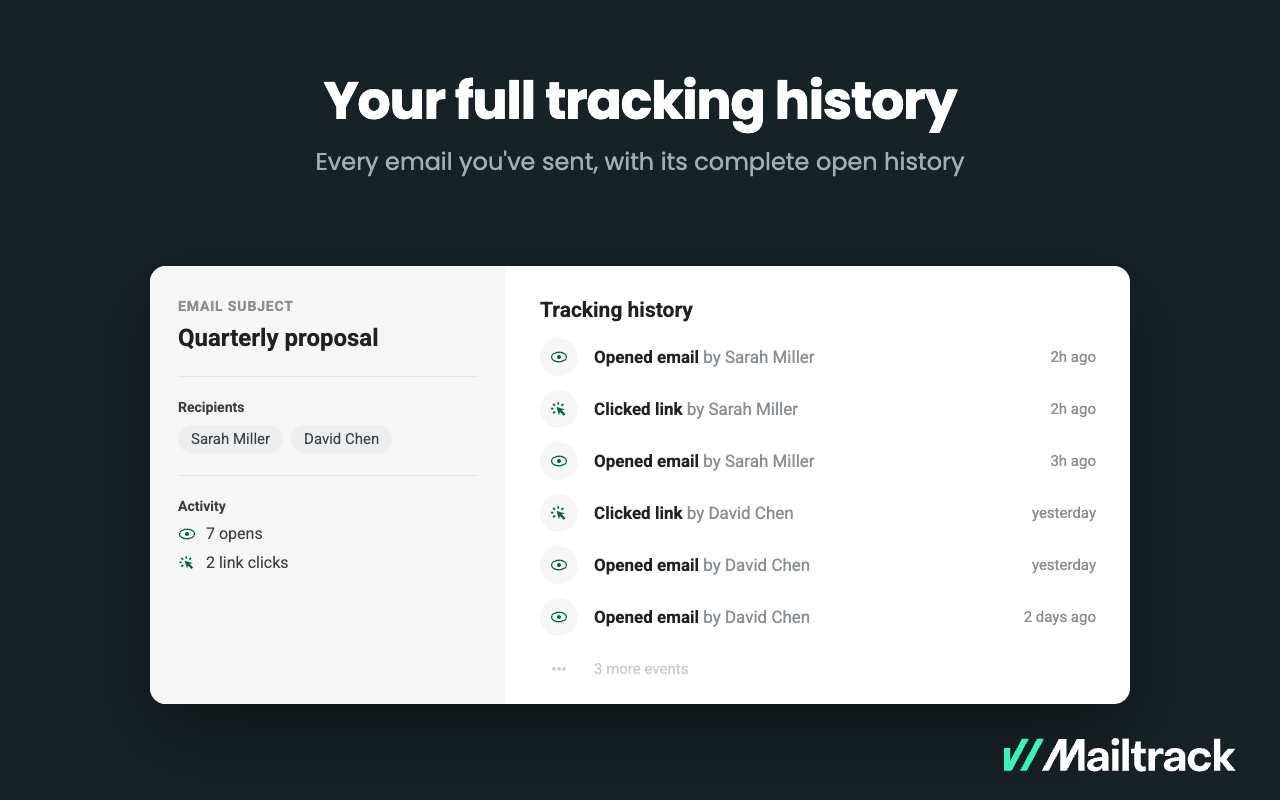
The screen above is what the marketing shows. Full history beyond seven days and the per-recipient breakdown both need the Mailsuite plan.
The billing terms are strict. Paid plans have no trial. Refunds are possible within 7 days of a charge, but not if the paid features have been used since, which in practice rules out "I tried it and it wasn't for me". Payment is by card or PayPal. Teams get 18% off from 5 accounts, 25% from 10 and 35% from 50, with no seat minimum.
Group emails, link clicks and campaigns
This is where the Free plan runs out for anyone using Mailtrack for work. Send a proposal to three people at a client and, below the Mailsuite plan, you can't see which of them opened it. For sales and recruiting, that per-person view is usually the whole reason to track.
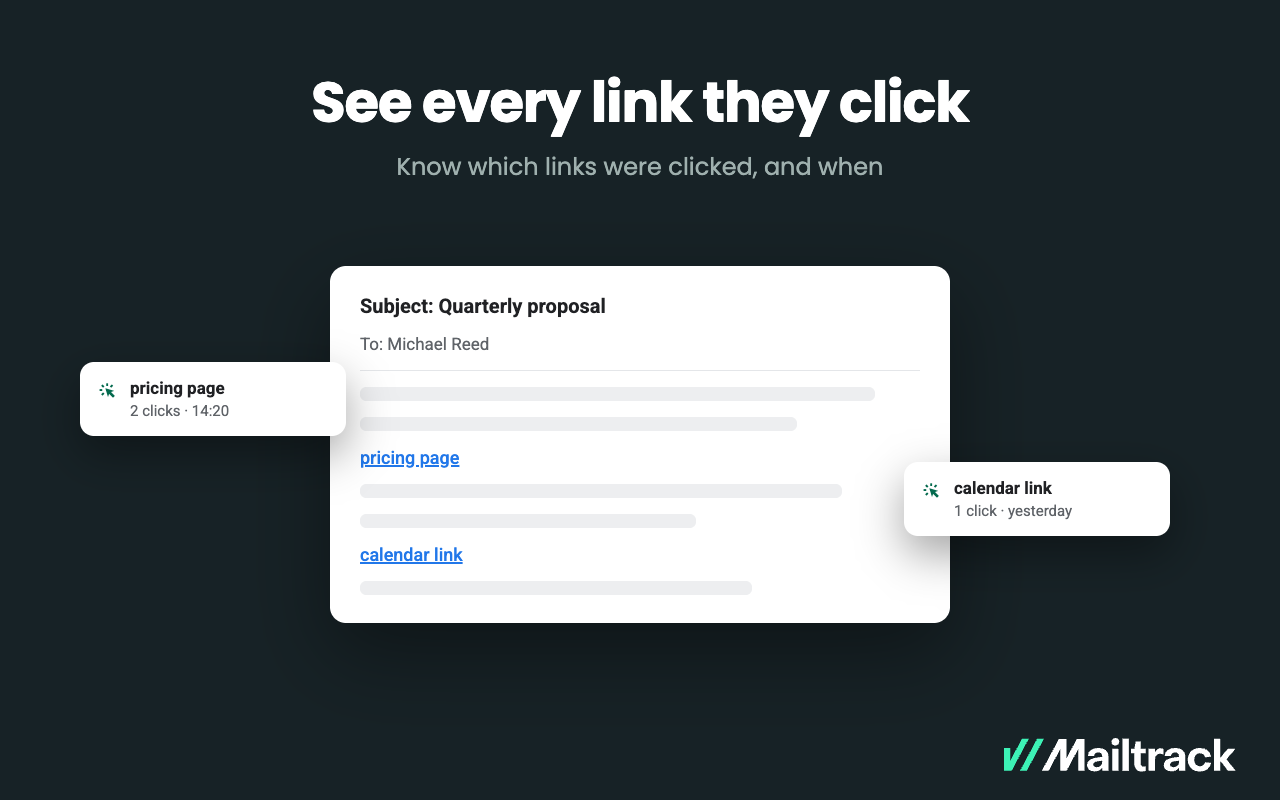
Links are similar. Click data covers just 10 emails on Free and Mailtrack, and click notifications are Mailsuite-only. A link is only tracked if it includes http:// or https://, so a bare "example.com" in the body slips through.
Mailtrack has campaigns too, but they are capped at 100 emails below the top plan, and mail merge personalisation, bounce detection and custom unsubscribe links are Mailsuite-only. If bulk sending is the actual job, a dedicated Gmail mail-merge tool like Mailmeteor fits better. CRM sync works by BCC or forwarding address to Salesforce, HubSpot and "a few other CRMs", again only on the $19.99 plan.
Follow-up alerts and where it runs
Some of the more useful pieces are free. Every plan gets instant open alerts in the browser, "hot conversation" alerts when an email is opened several times, and alerts when an old thread suddenly gets reopened. Reminders arrive 24, 48 or 72 hours after a still-unread email. No-reply alerts are basic below Mailsuite and custom on it.
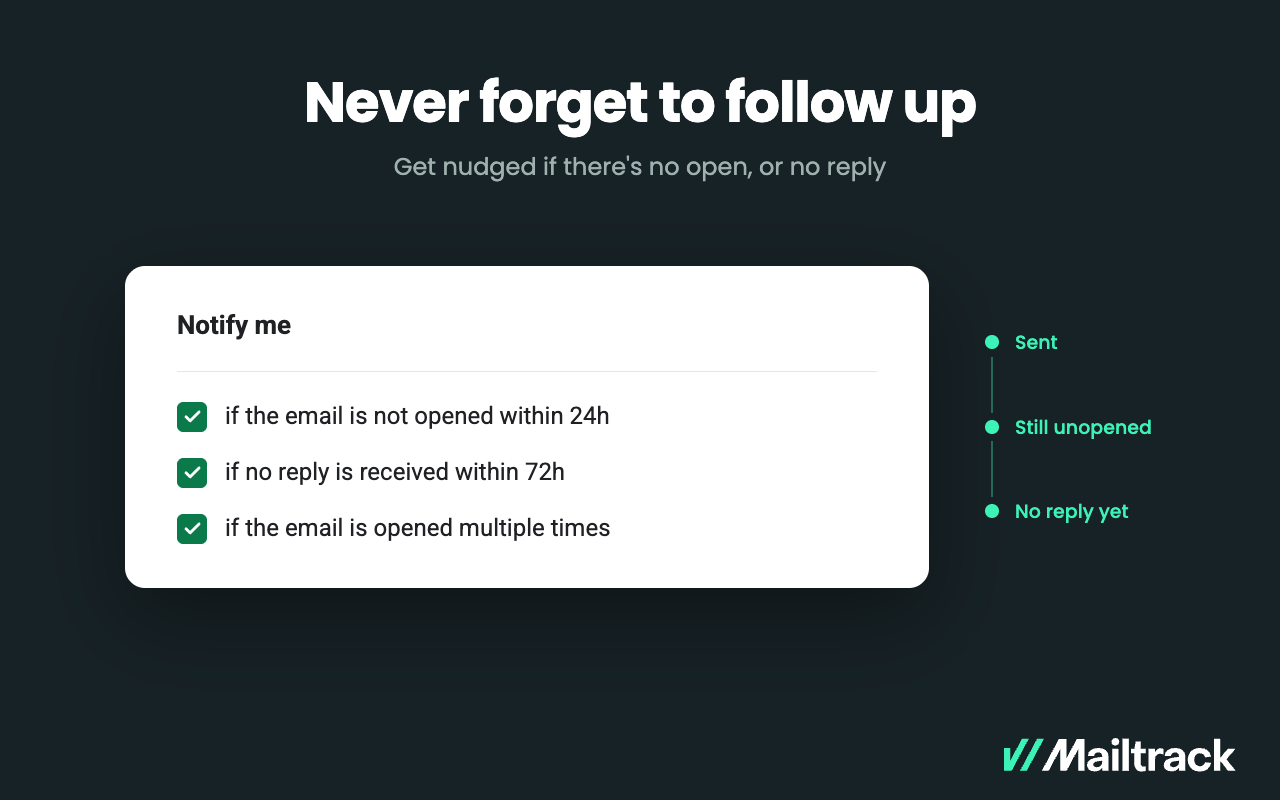
Email alerts on open are Mailsuite-only, and they fire for the first open only. A standalone app for iPhone, iPad and Android is on every plan. The Gmail-app add-on is lighter: tracking is turned on message by message and it doesn't run on tablets.
Paid Mailtrack works only in Gmail. The Outlook add-in is free and basic: open tracking with no dashboard, no link tracking and no per-recipient view. Paid plans also include an AI connector for Claude and ChatGPT, though not for accounts that sign in with Microsoft. If you send through Gmail from a Yahoo or Outlook address, note that Gmail drops "Send as" for third-party addresses from January 2027.
Permissions and privacy
The Google consent screen asks you to let Mailsuite "Read, compose, send, and permanently delete all your email from Gmail", and the help centre tells you to leave that box checked or the product won't work. The extension also asks to read and change data on mail.google.com. That is a lot of access for read receipts, and it is the price of any Gmail tracker that sends from your account.
What Mailsuite says it does with that access: production data sits in an AWS private cloud in Ireland, encrypted with AES-256, and email bodies are not stored on its servers. It goes through Google's annual security assessment as part of OAuth verification, and Mailsuite says it holds ISO information-security certification. As an EU company it treats you as the data controller for your recipients' data, with its privacy policy acting as the DPA. Accounts inactive for over a year may be deleted.
The recipient side is your problem, not Mailtrack's. On Free, the default signature tells every recipient they are being tracked. Pay to remove it and they no longer know.
What users complain about
The Chrome store rating is decent. Trustpilot is not: the mailtrack.io profile showed a TrustScore of 2.3 from 294 reviews on 2 November 2026, and Trustpilot notes the company hasn't replied to negative reviews. The most pointed one, from August 2026, is titled "Bait and Switch BEWARE" and says the free plan offers unlimited tracking but "blurs out the tracking, demanding an upgrade". That matches the design described above, where Free records every open but only shows the first.
Other recurring themes are billing that continues when the tool isn't working and support that doesn't answer. One reviewer on the separate mailsuite.com profile says free open notifications by email were removed without warning. The current table lists in-browser open alerts on Free, but email alerts are Mailsuite-only, which likely explains it.
Verdict: install Free, skip the middle, think hard about $19.99
Install the Free plan if you send one-to-one emails from Gmail and only want to know whether a message was probably opened before you follow up. The signature is the cost. Remove it on the emails where it matters, and you have a working tracker for nothing.
Skip the $6.99 Mailtrack plan unless repeat opens from the last week genuinely change what you do. The signature alone isn't worth $84 a year.
Pay $19.99 for Mailsuite only if you need to see who opened a group email, get click alerts or push opens into a CRM. At that price, compare Mixmax, which adds sequences and deeper CRM sync for Gmail sales teams, and Right Inbox if scheduling and reminders are what you're after.
Skip Mailtrack entirely if you live in Outlook or Apple Mail, where the free add-in is too basic: Mailbutler covers those clients. Skip it too if you need proof that someone read an email. A pixel can't give you that, and Mailtrack says so itself.
Ready to try Mailtrack?
Visit the official website to see the latest plans, pricing, and special offers.
Get Started - Mailtrack* Affiliate link - we may earn a commission at no extra cost to you.