Rocket.net Review: Cloudflare Enterprise on Every WordPress Plan, With Overage Fine Print
Rocket.net review: Cloudflare Enterprise on every plan from $25/month, independent speed and uptime data, overage fine print, and who should pick Kinsta instead.
Expert Review

What you are actually paying for
Most managed WordPress hosts sell you a server and let you bolt a CDN on top. Rocket.net does it the other way round. Every request to a site it hosts goes through Cloudflare's Enterprise network first, and only the 8-10% of traffic the edge cannot answer reaches the origin server. Rocket.net says Cloudflare Enterprise "usually starts at $6,000 a month per domain" and bundles it into a $30 plan. That figure is Rocket.net's, not Cloudflare's published price, but the feature list behind it is concrete: Argo Smart Routing with tiered caching, full-page caching with a cookie bypass so WooCommerce carts still work, and Cloudflare Polish converting images to WebP on the fly.
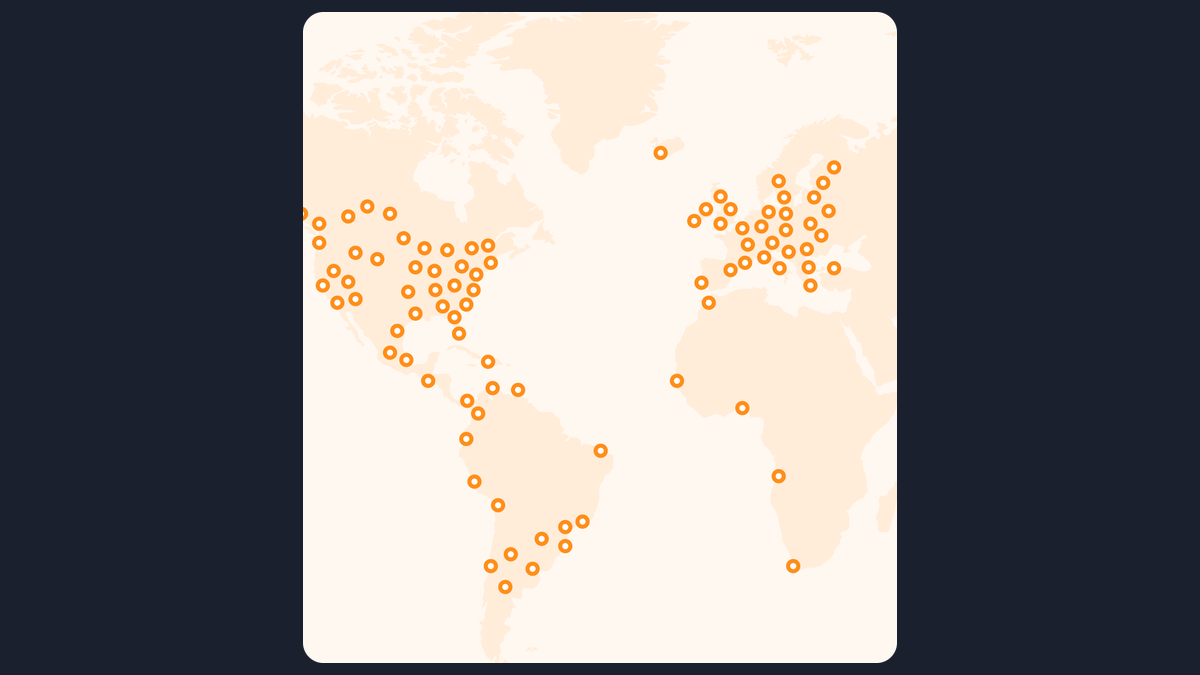
The network page counts "over 330 edge locations" (older help articles still say 250+). Behind them sit 10 origin data centres across the US, Europe and Asia, which you pick when you create a site. The origins are large shared machines - Rocket.net lists dual Intel Xeon Gold, 128GB RAM and NVMe storage - but it does not publish how much CPU or RAM a Starter or Pro plan actually gets. Only the dedicated Enterprise tiers come with a core count.
One wrinkle worth knowing before you migrate: if your domain's DNS already lives on Cloudflare, Rocket.net needs those records set to "DNS only", because the proxying happens on its account, not yours. Your own Cloudflare rules stop applying to the site.
The company itself is young. Rocket.net was founded in 2020 in West Palm Beach, Florida, by Ben Gabler, who previously worked at HostGator, GoDaddy and StackPath. In August 2025 it joined hosting.com in what it calls a "strategic partnership", and Gabler became hosting.com's Chief Product Officer. No price was disclosed. It is no longer an independent host.
Pricing and plans
Checked on the pricing page in October 2026 (the page was last updated in June 2026). Annual prices are shown per month and include two free months.
| Plan | Monthly | Annual (per month) | WordPress installs | Storage | Bandwidth |
|---|---|---|---|---|---|
| Starter | $30 | $25 | 1 | 10GB | 50GB |
| Pro | $60 | $50 | 3 | 20GB | 100GB |
| Business | $100 | $83 | 10 | 40GB | 300GB |
| Expert | $200 | $166 | 25 | 50GB | 500GB |
Every plan gets unlimited PHP workers, a 99.99% uptime guarantee, 30-day backup retention, free Redis and unlimited free migrations. The first month on any non-Enterprise plan costs $1. Rocket.net also promises it will "never do price hikes on renewals", which is the main thing separating it from Hostinger and SiteGround, whose cheap entry prices roughly double or triple at renewal.
Agencies get ten separate tiers, from $100/month for 10 installs up to $1,600/month for 200 installs, 375GB of storage and 3,500GB of bandwidth. Above that sit dedicated Enterprise servers from $649/month (8 cores, 64GB RAM) to $2,599/month (96 cores, 256GB RAM), which add Object Cache Pro, Relay, a private Slack channel and phone support.
Refunds: 30 days on everything except Enterprise. If you would rather not enter a card at all, Rocket.net will set up a no-card "test-drive account" on request through its contact form.
The fine print: "unmetered" visitors and overages
The pricing table lists visitors as "Unmetered" on every plan. The Terms of Service, last updated in August 2025, still say that "the sum of unique incoming requests that exceeds the allowance shall be billed at $1.00 per 1,000 visitors". And Rocket.net's own comparison page against WP Engine, updated in May 2026, still describes Starter as "1 WordPress Site, 250,000 Visits". Three documents, two different answers.

The dashboard agrees with the pricing page: the visitor tile reads "Unlimited" where disk and bandwidth show a hard cap.
That matters because of how a visitor is counted. The help centre is blunt: "Any HTTP GET request made to your site gets tracked", regardless of whether it came from a person or a bot. If the 250,000 figure were ever enforced, a Starter site that bots push to 300,000 counted visits would owe $50 on top of its $30 plan. We found no user report of Rocket.net actually billing visitor overages since the "unmetered" change, so read this as an inconsistency to ask sales about in writing, not proof of a hidden charge.
The overages that definitely apply are cheaper. Disk space beyond your plan costs $2/GB and bandwidth $0.08/GB, so a Starter site that uses 80GB of transfer in a month pays $2.40 extra. Mail is the other trap: WordPress can send password resets and order notices for free, but anything more than "informational or password reset emails" through Rocket.net's mail is billed at $1 per 1,000. A newsletter plugin sending 20,000 emails a month would add $20 - route it through a proper sending service instead.
There is also no email hosting at all. Rocket.net points you to Google Workspace, Microsoft 365 or Zoho Mail, so budget for that separately if your domain needs mailboxes.
Speed and uptime: claims versus measurements
The homepage puts Rocket.net at about 83ms against Kinsta at 504ms and WP Engine at 616ms, with no test method published. Treat those as advertising.
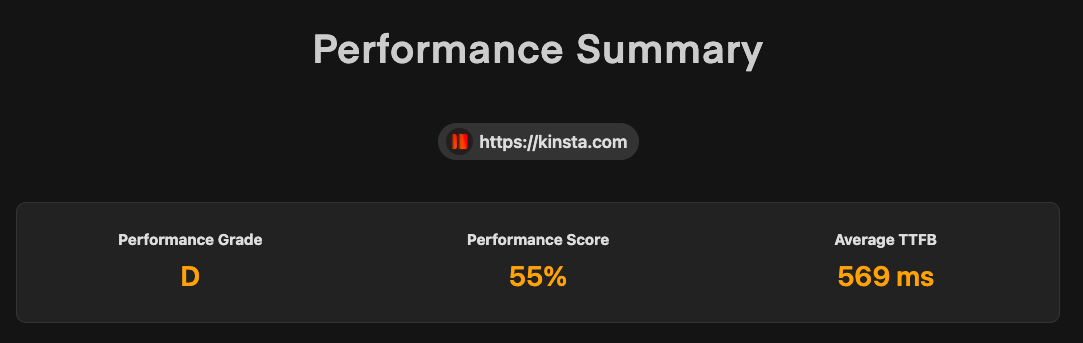
That screenshot is Rocket.net's own: a SpeedVitals run against kinsta.com's marketing homepage, not a like-for-like test of two hosted sites.
Review Signal's WordPress Hosting Performance Benchmarks placed Rocket.net in the Top Tier of the $25-50 bracket in 2021 and again in 2023, with a 22ms average response time and 31ms at the 95th percentile under load. Its Enterprise plan was Top Tier in 2023 too, with the fastest average in that group at 187ms.
HostingStep, which monitors a live test site, measured an average TTFB of 346ms and 99.97% uptime between October 2025 and May 2026, with seven outages adding up to 1 hour 44 minutes; one of them was traced to Cloudflare itself. That is below the 99.99% guarantee. It also matches the sharpest complaint we found on Trustpilot, where the score sits around 4.8: a customer in the Netherlands wrote in July 2026 that all their sites had been down for almost a whole day on the Dutch node, and that "It isn't a reliable host anymore." One review and one monitor do not make a trend, but they are the reason we would not pick Rocket.net purely on its uptime promise.
Day to day: setup, tools and support
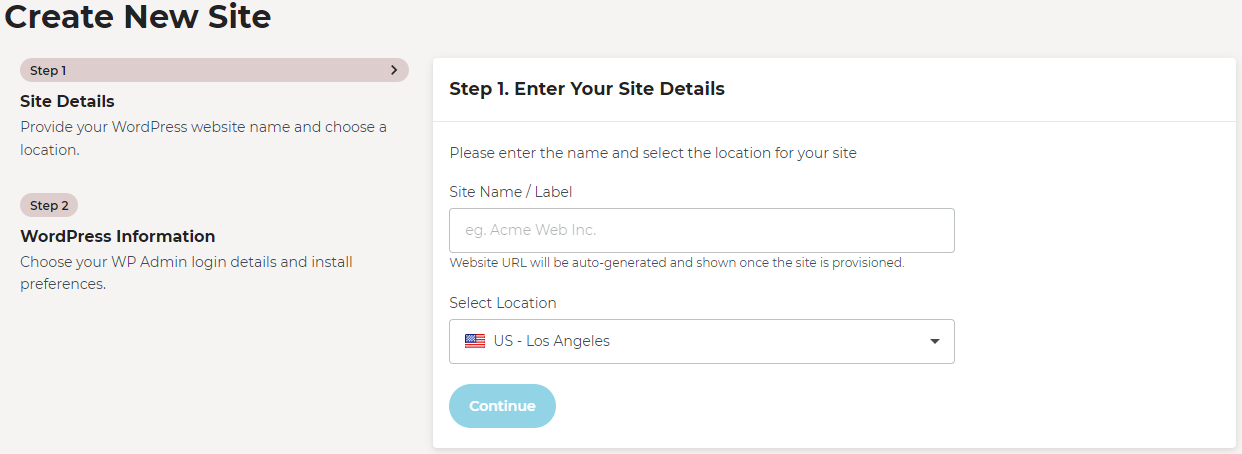
Creating a site is a two-screen form: pick an origin location, then name the install and toggle Multisite, WooCommerce or a set of recommended plugins. Staging is free, user seats are unlimited, and SFTP, WP-CLI and SSH are on every plan. SSH is key-only; Rocket.net does not allow password logins. There is a public API and an official MCP server so Claude, Gemini or ChatGPT can manage sites, backups, SSL and staging - handy for agencies, irrelevant for a single blog.
Security is handled at two layers: the enterprise WAF at the edge and Imunify360 on the server for malware scanning and patching. The flip side of that stack is a short list of plugins that "may need to be disabled or removed", including WebP Express, WP Cloudflare Page Cache and Yet Another Related Posts Plugin. If your site depends on one of those, check before you move.
Support is 24/7 chat and tickets on every plan. Rocket.net says it answered more than 45,000 chats in 2024 with an average response time of 41 seconds. The engineers are WordPress specialists, but "we typically draw the line at code changes", so a broken theme is still your problem. Phone support exists only on Enterprise plans. Migrations are free and unlimited, and Rocket.net says 95% finish within 12 hours.
Leaving needs more care than joining. Cancellation must be in seven days before your next billing date, and "all data is permanently deleted and cannot be recovered once the account is canceled". The ToS also make backups your responsibility. Download a full backup before you press Cancel.
Verdict: who should buy Rocket.net, and who should not
Buy it if you run a WordPress or WooCommerce site whose visitors are spread across continents and you want edge caching, a WAF and image optimisation without configuring any of it. At $25/month billed annually, with no renewal increase, it undercuts Kinsta's entry plan while giving every site a full Cloudflare Enterprise setup. Agencies get the best deal of all: unlimited users, free migrations and an API on tiers that scale to 200 sites.
Skip it if anything you host is not WordPress. Rocket.net answers that question with "we specialize in WordPress only", so a Node app, a static site or a separate database means a second host - Kinsta runs apps and databases next to WordPress, and Cloudways gives you a whole server for any PHP app. Skip it too if $30/month is a stretch for one small site: Hostinger and SiteGround cost a fraction of that in the first term, as long as you plan for their renewal prices.
If you do sign up, use the $1 month to watch the visitor counter in the dashboard and ask support, in a ticket you can keep, whether the per-visitor overage in the Terms still applies to your plan.
Ready to try Rocket.net?
Visit the official website to see the latest plans, pricing, and special offers.
Get Started - Rocket.net* Affiliate link - we may earn a commission at no extra cost to you.