Uncanny Automator Review: An AI Agent Inside wp-admin, a $300 Pro Plan and a Backdoored Update
Uncanny Automator review: the free recipe builder, the new Uncanny Agent, $300 Pro vs the $199 Legacy plan, 250 app credits, and the June 2026 Pro update breach.
Expert Review

What changed in 2026
For most of its six years on WordPress.org, Uncanny Automator was a recipe builder. Pick a trigger from one plugin ("user completes a LearnDash course"), pick an action in another ("add a tag in FluentCRM"), save. That part still works. What changed in 2026 is everything bolted around it.
On May 6, 2026, Uncanny Owl, the Toronto company behind the plugin, shipped Uncanny Agent, an AI assistant that lives in wp-admin. The vendor's launch post says it "drafts content, updates settings, runs queries" and "wires up the recipe directly" when you describe an automation in plain English. On August 11 came Uncanny Page Builder, which has the same agent write whole pages.
The same summer, the Pro update server was broken into and shipped a backdoored build for about 22 hours. So this review, checked on September 28, 2026 against version 7.6.1.1 (released September 3), has two questions the older reviews never had to ask. Do you want an AI agent with admin reach on your site? And is this the plugin you want providing it?
The free version is the real product
This is where Uncanny Automator beats its niche. The FAQ says "all WordPress triggers and actions in the free version are completely unrestricted", and the listing promises unlimited WordPress plugin automations. Recipes between WooCommerce, LearnDash, MemberPress, Gravity Forms, BuddyBoss and core WordPress events cost nothing, and so do outgoing webhooks and emails. It runs on 40,000+ sites and holds 4.9 out of 5 from 157 ratings.
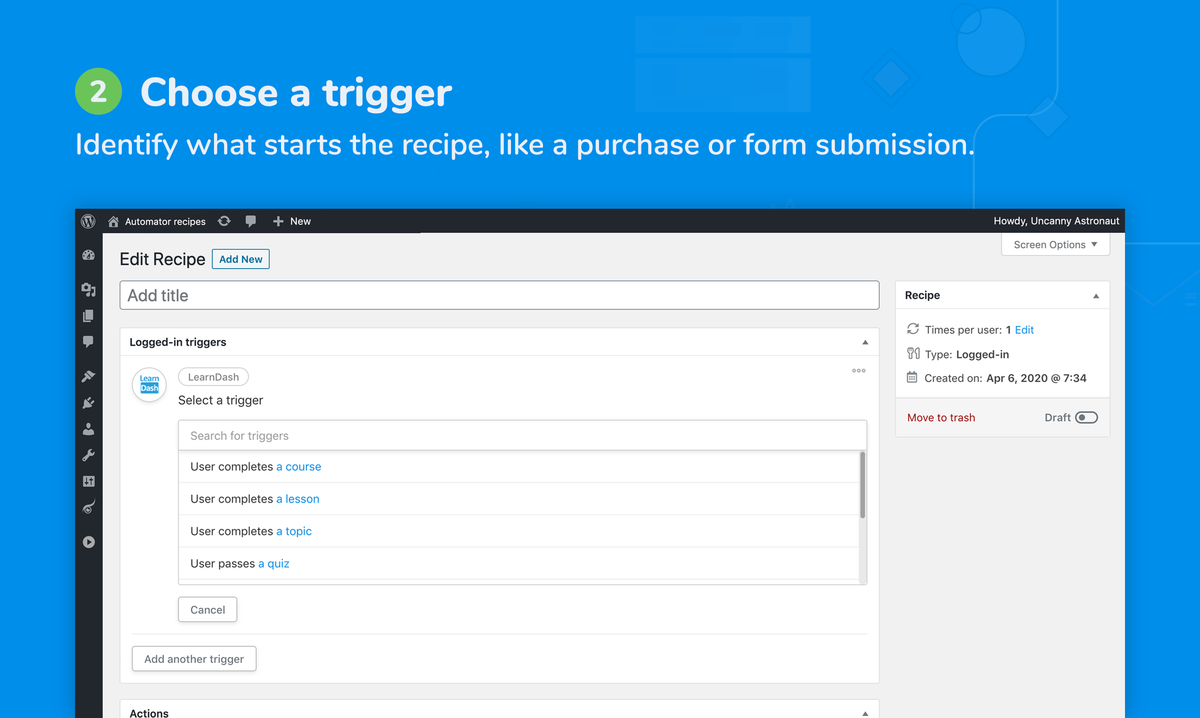
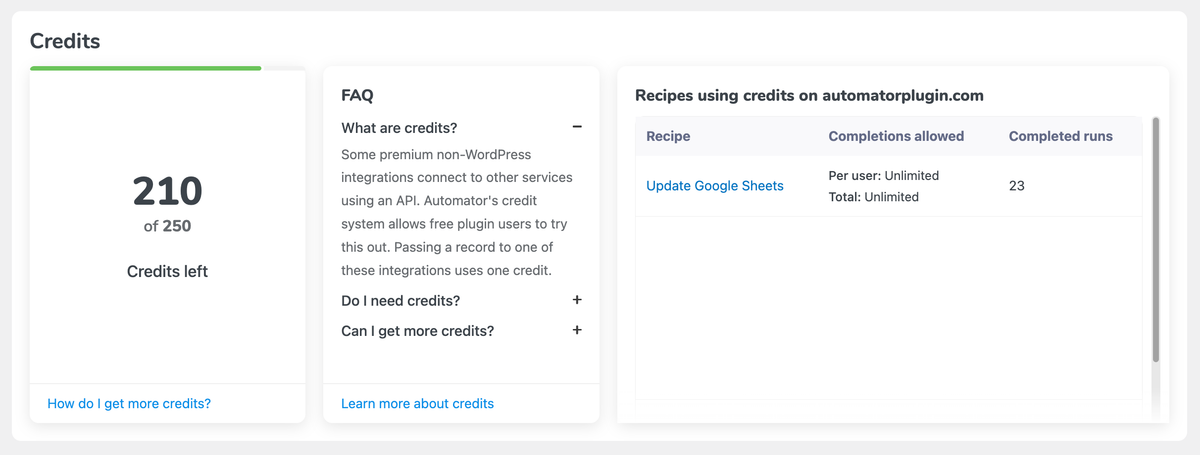
The limit sits at the edge of WordPress. Anything that pushes data to an outside service through Uncanny's API layer spends one app credit per run: a new row in Google Sheets, a Slack message, a Zoom webinar registration, a Mailchimp subscriber. A free account gets 250 credits. The vendor never says they refill, so treat them as a one-time allowance, and they are shared across every site on that free account, staging copies included. A shop that logs each WooCommerce order to a sheet can spend all 250 in a busy week.
Free also has no delays or schedules, no conditions, no loops, no incoming webhooks and no database queries. That is the line that decides most purchases. "Send a welcome email when someone enrols" is free. "Send a follow-up three days later if they have not opened lesson one" is Pro.
Uncanny Agent and Page Builder
The Agent is a chat panel in wp-admin. The vendor's example prompts show the range it aims at. "How many orders came in yesterday?" is a query. "Create an automation that enrolls customers in Course A when they purchase Product B, and sends them a welcome email" is a recipe it assembles for you, and a drip campaign with follow-ups at 3 and 7 days is a recipe with delays. With a dozen integrations installed, the trigger dropdowns run long, so this saves real time.
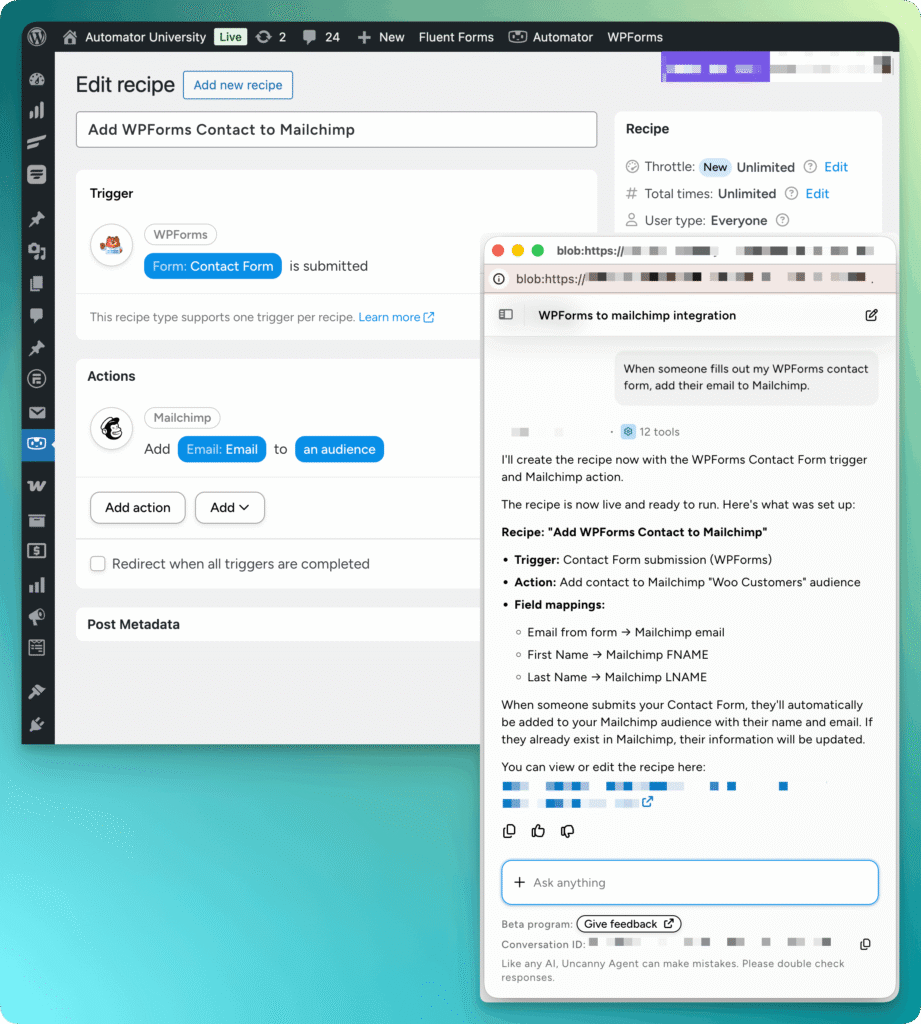
Two things are missing from the pitch. The launch post never names the model or the provider underneath. No API key is needed, which also means you cannot tell which model reads your order data or whether it changes between releases. And usage is metered with a meter nobody shows you. Every AI + Automation plan gets "Monthly" usage that refills and "Anytime" usage that lasts the plan year; Plus gets twice the standard amount, Elite four times. The pricing page never says what the standard amount is, in messages, tokens or anything else. Even the refund depends on it: the 14-day money-back guarantee holds only "as long as you've used 5% or less of your Uncanny Agent usage".
Page Builder is the newer and odder addition. You describe a page, the Agent builds it in vanilla HTML and CSS rather than proprietary markup, and you can download the result as standalone HTML. That is a cleaner exit than page builders that store layouts in their own format. It needs PHP 8.1, against 7.4 for the rest of the plugin. It is also a page builder inside an automation plugin, the scope creep that makes the security section matter more.
Pricing: $300 with the AI, $199 without
Prices are from the pricing page as archived on August 15, 2026; the live site blocked our fetch on September 28. Every plan is annual, renews automatically and includes a year of updates and support. There is no monthly billing and no lifetime deal.
| Plan | AI + Automation | Legacy (recipes only) | Sites |
|---|---|---|---|
| Basic | $300/year | $199/year | 1 |
| Plus | $480/year | $349/year | 10 + multisite |
| Elite | $720/year | $599/year | 50 + multisite |
The "$25/month" headline is Basic's $300 divided by twelve and charged up front. The Legacy column is the useful find. The same page still sells the Recipe Builder with its Pro triggers and actions and without the Agent, and on one site the AI costs $101 a year more, a 51% markup for an allowance you cannot see. Plus adds 2x Agent usage and three addons; Elite adds Salesforce, QuickBooks Online and 4x usage.
Smaller print worth knowing before checkout: upgrades cost the difference but "do not extend the renewal date", and nobody gets a second refund. The vendor compares $25 a month here with Zapier or Make at $20-50 plus a $20 chatbot. That sum only holds if the Agent's unpublished allowance covers your work.
The security record
On June 12, 2026, around 6:30 PM EDT, an attacker used a flaw in third-party software on automatorplugin.com to reach the Pro update infrastructure. For about 22 hours the updater served Uncanny Automator Pro 7.3.0.5, a build that never appeared in the changelog. It added an unauthenticated "magic login" and sent the site's auth keys and admin credentials to attacker servers. The clean 7.3.0.6 shipped on June 13. Fewer than 6% of active installs took the bad build, and the free plugin from WordPress.org was not affected. The attacker also got into the store database: customer names, emails, license keys and site URLs were exposed, card data was not. It is tracked as CVE-2026-12375, CVSS 9.8.
The vendor's advice for affected sites was blunt and correct. Treat the site as fully compromised, reset admin passwords, regenerate the secret keys, and look for the option _wpc_uid and the transient _wpcs. If you ran Pro in mid-June and never checked, do that first.
The breach did not arrive alone. June and July brought at least five more high or critical CVEs, all patched now. Two were PHP object injection bugs reachable by a subscriber or by anyone at all (CVSS 9.8 and 8.1). A third came through the Forminator integration's fr_token and could chain into file deletion and remote code execution; it was fixed in 7.4.0 on July 14, and IONIX reported ongoing exploitation attempts. An admin-level SQL injection and a subscriber data leak followed. In 2025 a subscriber could make themselves administrator (CVE-2025-2075). OpenCVE lists 18 CVEs for the product in total.
Plugins that touch every other plugin collect bugs; OttoKit had two exploited ones. What is new is the combination: an agent inside an automation plugin that "updates settings" and "runs queries" widens what one bad bug or one bad update can do. Update through the official updater only, and keep the Agent off production sites where an unexpected settings change costs money.
What users report
The support forum is where the 4.9 rating gets its context. The recurring thread is an integration breaking after an update. In "Learndash integration not working since 7.3.0", quiz score and answer tokens came back empty; the developer reproduced it and sent a patch to test. Others report a site-wide fatal error after the 7.0.0.3 update, and Pro recipes causing 503 errors and CPU spikes. Stage updates before they reach a live membership site.
A less obvious one: a user could not restore a wp db export or mysqldump backup because Automator creates database views, which the developer called "a common challenge when migrating views". If your host's migration tool handles views badly, test a restore before you need one.
One January 2026 one-star review calls it "seemingly incapable of integrating with WordPress and Thrive Apprentice". Check that your LMS or membership plugin is on the list of 230+ integrations (as of August 2026) before paying for anything.
Verdict
Install the free version if you run WordPress with more than two plugins that ought to talk to each other. Unrestricted WordPress-to-WordPress recipes for nothing is still the best offer in this category, and the free build was never part of June's breach.
Buy Pro if you run a LearnDash, MemberPress or WooCommerce site and need what free lacks: delays, conditions, loops, or outside-app actions past 250 credits. Buy the Legacy plan unless you specifically want the Agent. It is $199 against $300 on one site, and it keeps an AI with settings access off a production site.
Skip it if your automations mostly run between SaaS apps rather than WordPress plugins; Zapier or one of the tools in our workflow automation roundup works without a WordPress site in the middle. Skip it if you want to pay once: OttoKit sells a $499 lifetime plan. And if the Agent is the reason you are here, wait until Uncanny Owl publishes which model it runs and how much usage a plan buys. Right now the extra $101 a year pays for a number the vendor will not tell you.
Ready to try Uncanny Automator?
Visit the official website to see the latest plans, pricing, and special offers.
Get Started - Uncanny Automator* Affiliate link - we may earn a commission at no extra cost to you.