UseArticle Review: An AI Writer That Builds the Whole Affiliate Site
UseArticle review: the AI tool that builds a full affiliate site and auto-publishes it. Pricing, the BYOK OpenAI catch, and who should skip it. Checked September 2026.
Expert Review

It builds the site, not just the post
Most AI writing tools hand you a draft and stop. You still open your CMS, format the piece, drop in the affiliate links, and remember to hit publish next week. UseArticle takes the rest of that job too. Point it at a product, and it stands up a working affiliate property around the articles: a homepage, category pages, the affiliate links wired in, and a publishing schedule that runs without you touching it.
That framing matters, because it changes what this review has to judge. A single article you can read and grade. An automation you have to grade on what it does over 90 days while nobody is watching, and on where it quietly cuts corners. This piece is sourced from the vendor's own product and pricing pages and its AppSumo listing, checked in September 2026, not from a long hands-on run, and I have flagged the places where that distinction matters.
How the pipeline runs
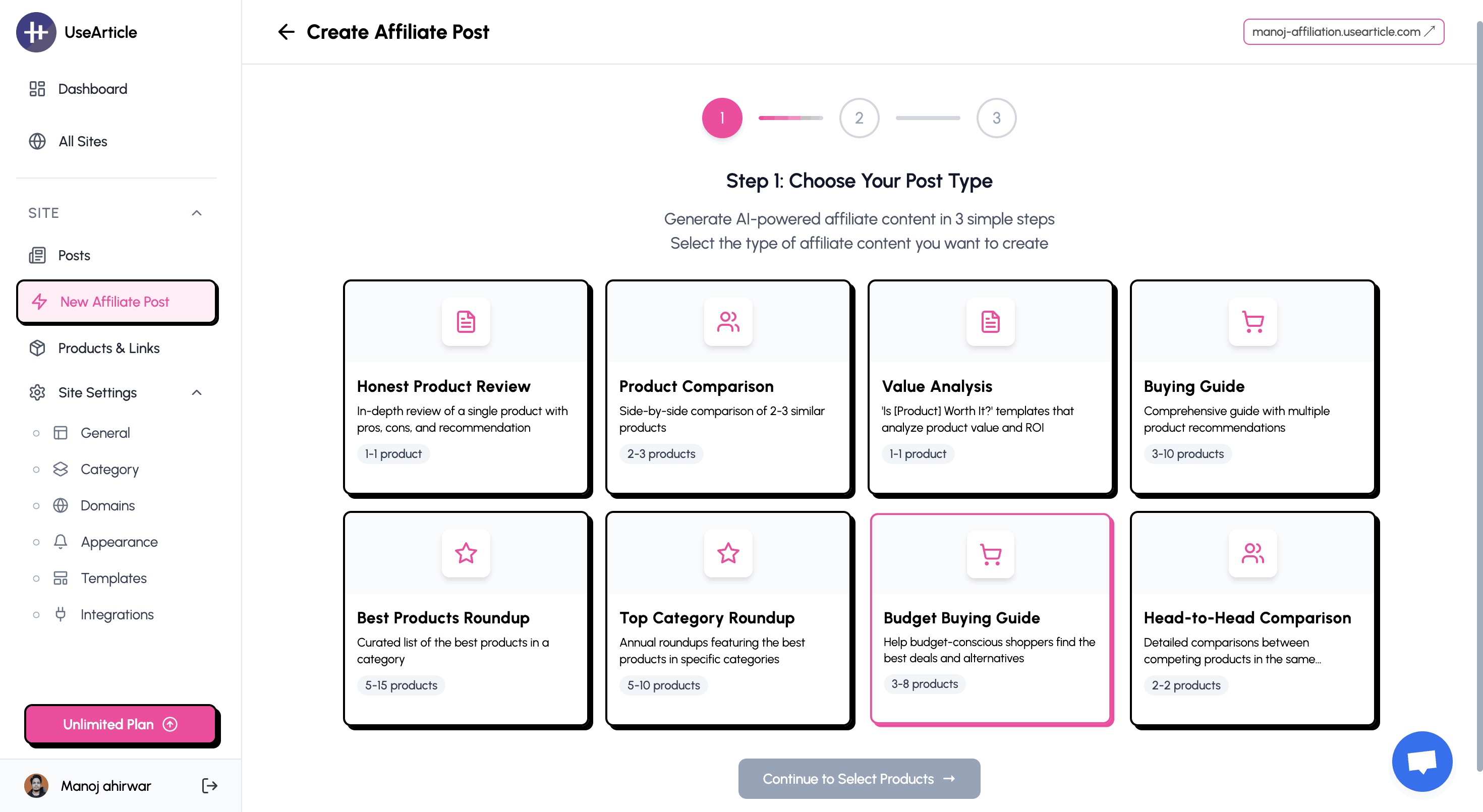
The starting point is a URL. You paste a product link, or pick from a built-in marketplace of 100-plus affiliate programs, and UseArticle extracts the product data, then generates the content in a tone you set, with the affiliate links already inserted, published to your own custom domain. There are 13 templates behind it: reviews, comparisons, buying guides, gift guides, alternatives, and problem-and-solution pieces. Content can be generated in 15-plus languages, from English and Spanish to Hindi and Japanese, selected in-app.
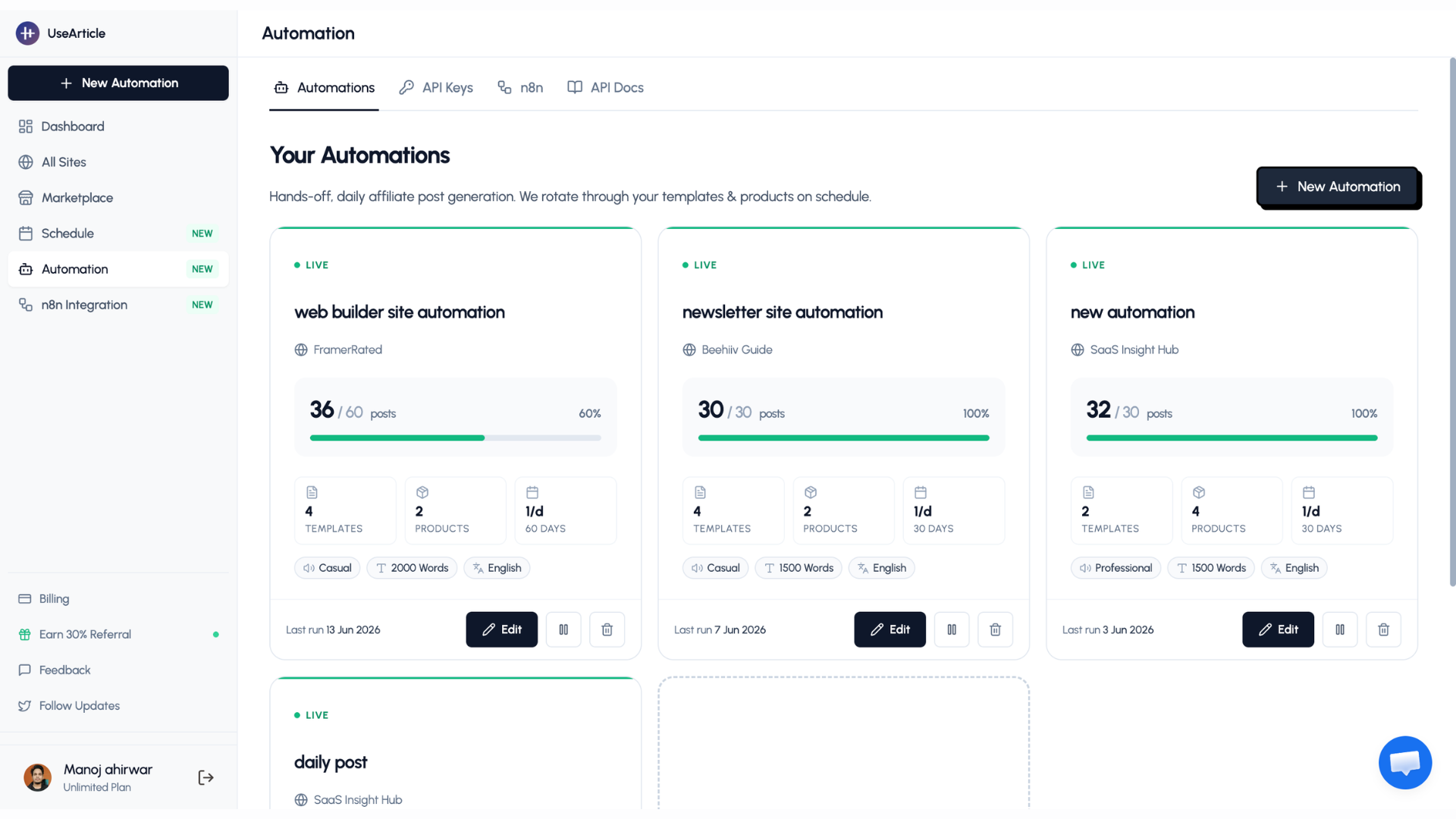
Setup is per-automation. You configure one automation to target a niche or a program, and it produces posts against that brief on a repeating cadence. The whole appeal is that you write the brief once and the output keeps landing, so the real question is not whether it can write a review but whether the tenth unattended review is still worth publishing.
Scheduling and volume
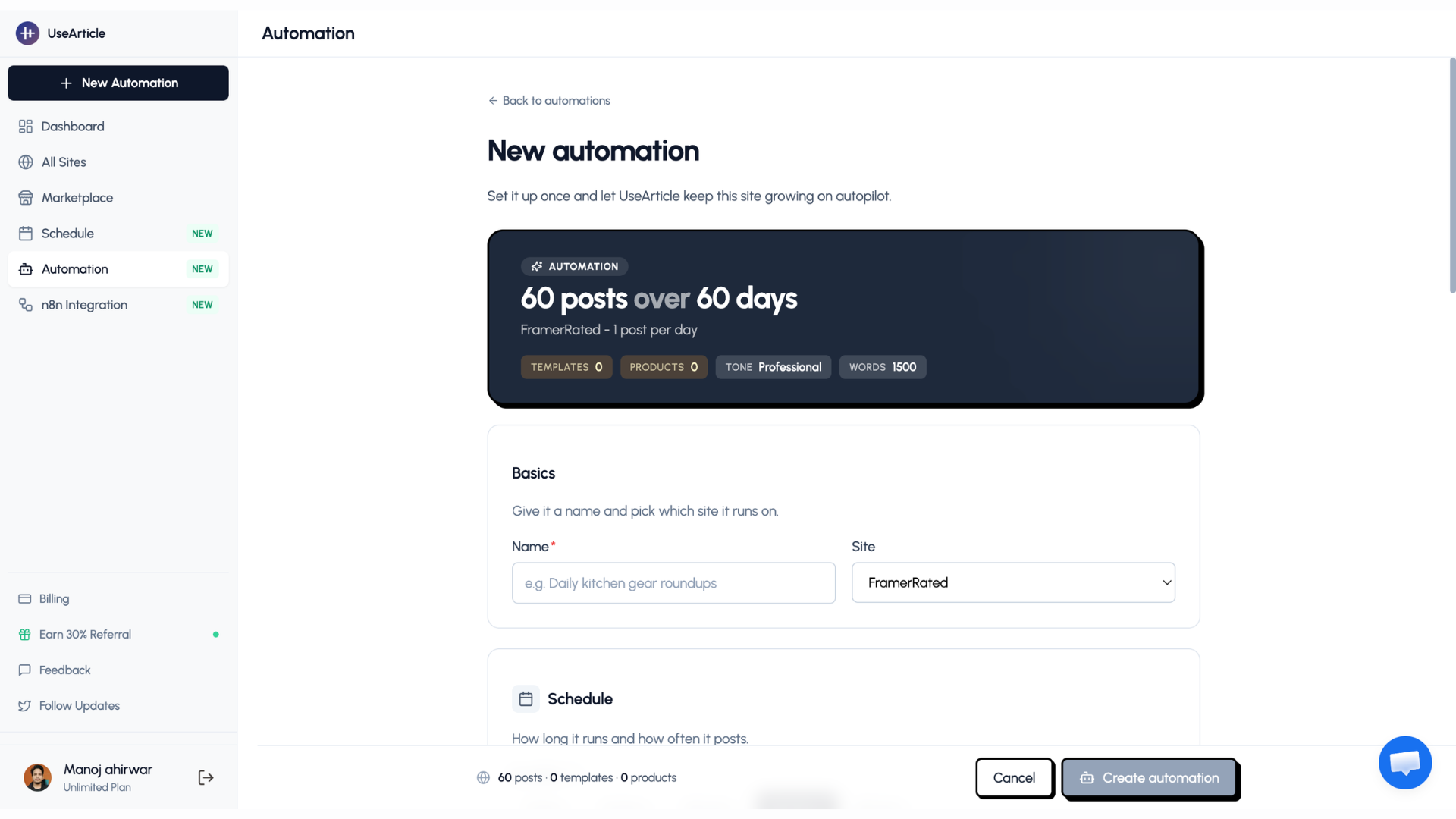
An automation can be set to publish one or two posts a day, scheduled up to 90 days out, so you can fill a quarter of a content calendar in one sitting and leave it. How much you can run at once is gated by your plan, not by the feature: the entry plans cap you at two active automations, the mid plan at five, and the top AppSumo tier at ten. If your model is one busy site, two automations is plenty. If it is ten thin niche sites at once, the automation cap is the number to read before the price.
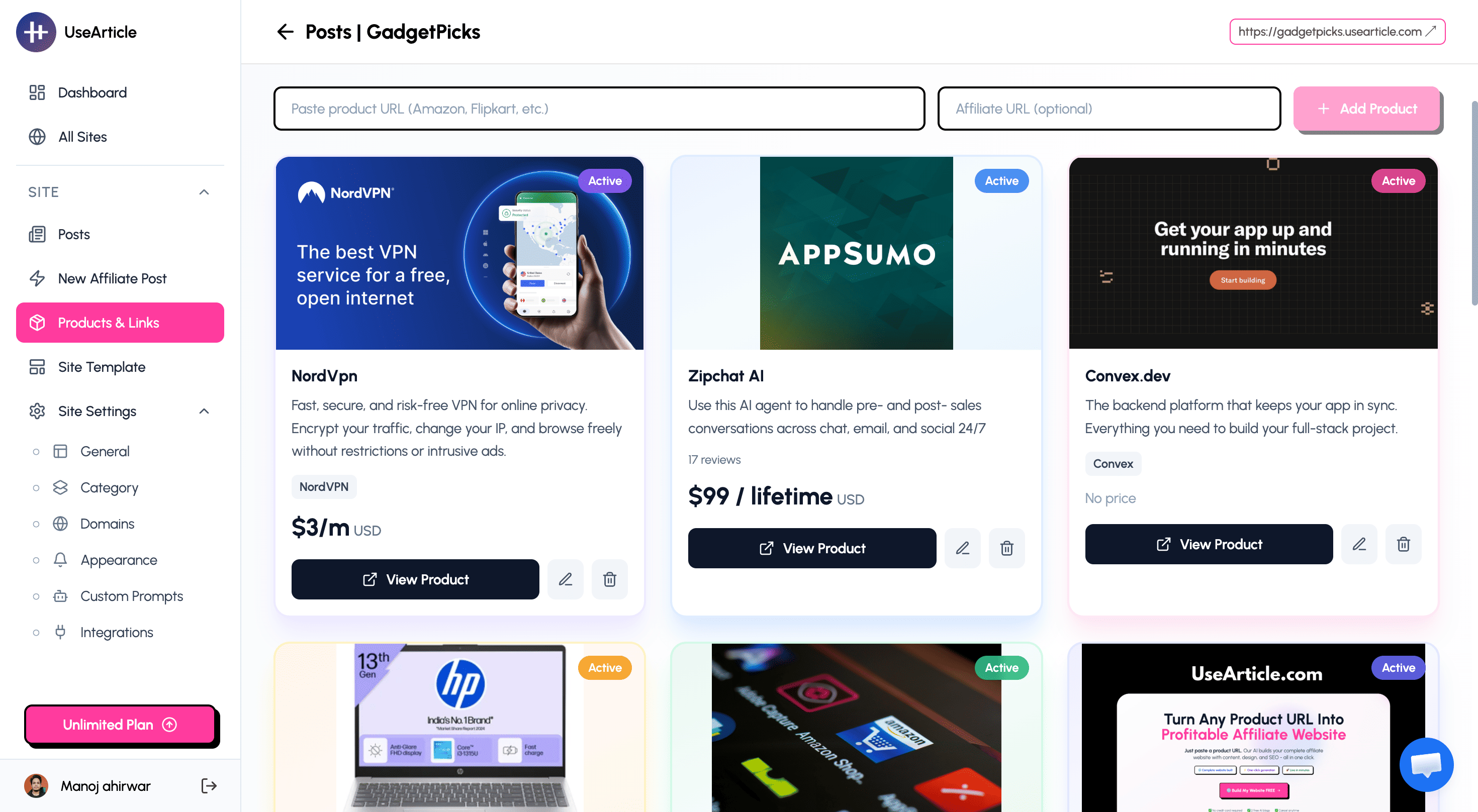
The dashboard tracks each automation's state, so you can see which sites are producing and which have stalled. It is monitoring, not editing: nothing here reads a draft for you and decides it is too thin to ship.
Pricing runs on two tracks that do not line up
The confusing part of buying UseArticle is that the same product sells two different ways, and the cheaper one is not on the main site. Prices below were checked on the pricing page and the AppSumo listing in September 2026.
On usearticle.com the plans are recurring. Base is $23 a month billed yearly, or $29 billed monthly, and gives you up to 2 automations, 3 websites, 100 blog posts per website, unlimited products, all 13 templates, API access for n8n and custom integrations, a custom domain, and branding removal. Unlimited is $39 a month billed yearly, or $49 monthly, and lifts the caps to 5 automations and unlimited websites and content, adding auto-generated thumbnails and priority support. Both carry a 7-day free trial. There is also a BYOK Lifetime option at $250 once, with 5 automations and unlimited sites.
Read that BYOK line closely. Its "unlimited AI-generated blogs" is only unlimited on UseArticle's side. You supply your own OpenAI API key, and OpenAI bills you directly for every generation, so the true running cost is $250 plus whatever your token usage comes to. The headline number leaves that second meter out.
The AppSumo listing is the other track, and it is a one-time lifetime deal rather than a subscription. Tier 1 is $49 once (listed at $360) for 3 websites, 100 posts per site, and 2 automations. Tier 2 is $119 once (listed at $600) for unlimited websites, unlimited posts, and 10 automations. Same core feature set as the direct plans: the 13 templates, 15-plus languages, auto thumbnails, API access, custom domain, and branding removal.
For most buyers the AppSumo math wins. Tier 2 at $119 once gives you unlimited sites and more automations than the direct Unlimited plan, which runs $39 a month and passes $119 in about three months. There is also a refund gap worth knowing: the AppSumo deal is refundable up to 60 days under its "We Got Your Back" guarantee for Plus members, while a direct purchase gives you only the 7-day trial before the card is charged. If you want time to judge the output on your own niche, 60 days of that is a very different bet from 7.
Where it falls short
The biggest limit is evidence, not a feature. At the time of this check the AppSumo listing carried only two user reviews, both 5-star, with no documented complaints. Two ratings is far too small a sample to read as proof of quality, so treat the mechanics, which are verifiable, as the real basis for a decision, and treat the ratings as noise.
The automation model has a built-in tension too. The product's value is unattended volume, but unattended volume is exactly how thin, near-duplicate affiliate pages get published at scale, the kind search engines have spent the last two years demoting. Nothing in the dashboard grades a draft before it ships. If you run this without reading the output, you are trusting a template to stay on the right side of a line that Google keeps moving, and that is a real risk the marketing does not mention.
Two smaller cautions. The BYOK plan's OpenAI bill, covered above, means the cheapest lifetime option is not actually a fixed cost. And there was no completed free-tier walkthrough in this research, so I cannot tell you first-hand how many clicks it takes to reach a first published post or how good that first post reads; the 7-day trial is where you would confirm that before paying.
Who should buy it, and who should skip it
Buy UseArticle if you run affiliate sites as a volume game and you will still edit what it produces. The combination of a program marketplace, site scaffolding, and a 90-day schedule genuinely removes the busywork of standing up and feeding a niche site, and at $119 once on AppSumo the downside is capped and refundable for 60 days. That is the buyer this is built for.
Skip it if what you actually want is one strong flagship article you will be proud to rank. A site builder tuned for unattended volume is the wrong shape for that, and you are better served by a general assistant plus your own CMS, where you control every paragraph. And if you want bulk SEO posting but not the storefront around it, tools like Byword or Journalist AI cover the write-and-publish half without the affiliate-marketplace layer, so weigh whether that scaffolding is something you will actually use. The honest test is simple: if you will read the output, this saves you real time; if you will not, it will publish pages you would not have.
Ready to try UseArticle?
Visit the official website to see the latest plans, pricing, and special offers.
Get Started - UseArticle* Affiliate link - we may earn a commission at no extra cost to you.